Rabindranath Tagore Jayanti: A Living Legacy
27 Visited Important Days (Diwas) • Updated: Thursday, 07 May 2026
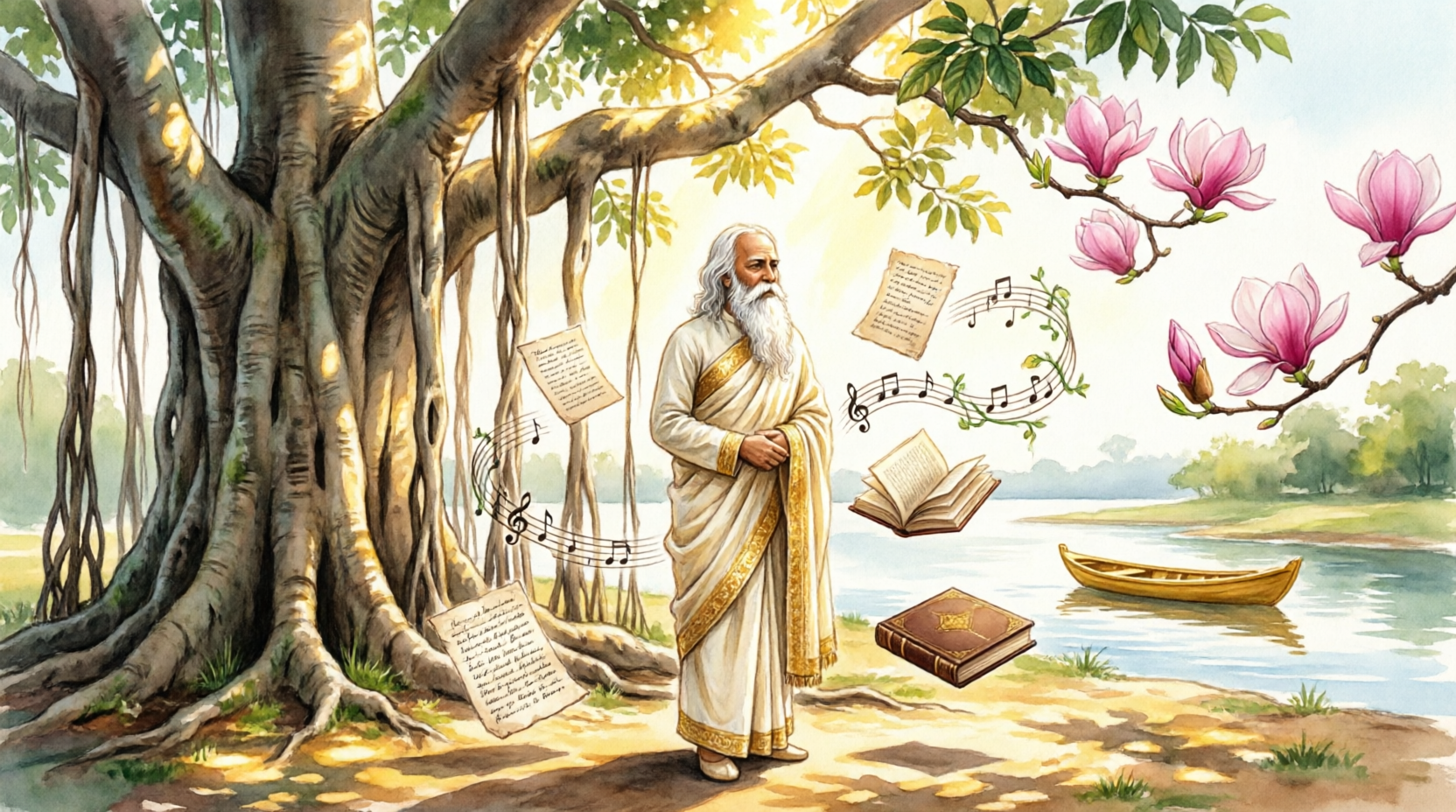
Rabindranath Tagore Jayanti: A Living Legacy on May 7, 2026
Published: Thursday, May 7, 2026
Reading Time: ~18 minutes
Tags: #TagoreJayanti #RabindranathTagore #IndianLiterature #BengalRenaissance #VisvaBharati #RabindraSangeet #CulturalHeritage #May7
Introduction: The 25th of Baishakh in a Gregorian World
Today, Thursday, May 7, 2026, marks Rabindranath Tagore Jayanti, the annual celebration of the birth of one of the most luminous minds to emerge from the Indian subcontinent. While many observe it as a fixed date in the Gregorian calendar, its true anchor lies in the Bengali lunisolar calendar: the 25th of Baishakh. Historically, this date shifted between late May and early June, but following calendar reforms in the mid-20th century, May 7 became the widely accepted Gregorian equivalent in India and Bangladesh. In 2026, we honor the 165th birth anniversary of a poet, philosopher, composer, educator, painter, and visionary whose work continues to ripple across centuries, borders, and disciplines.
Tagore is not merely a historical figure to be archived in textbooks. He is a living conversation. His verses are sung in village courtyards and metropolitan concert halls alike. His ideas on education are revisited by pedagogues grappling with AI-driven classrooms. His warnings against aggressive nationalism feel startlingly urgent in a polarized global landscape. On this May 7, we step into the world of Gurudev not to mourn a man who left in 1941, but to commune with a presence that refuses to fade.
This blog post is an invitation: to remember, to reflect, to read, to listen, and to carry Tagore’s humanism into the complexities of our present.
The Man Behind the Myth: Birth, Lineage, and the Bengal Renaissance
Rabindranath Tagore was born on May 7, 1861, into the illustrious Thakur (Tagore) family of Jorasanko, Calcutta. His grandfather, Dwarkanath Tagore, was a pioneering industrialist and social reformer. His father, Debendranath Tagore, was a leading figure in the Brahmo Samaj, a progressive religious movement that sought to reform Hinduism by rejecting idolatry, caste rigidity, and scriptural literalism in favor of rational spirituality and ethical living.
The Tagore household was not just wealthy; it was intellectually vibrant. Visitors included scholars, musicians, theater artists, and reformers from across India and Europe. Yet, childhood was not without sorrow. Rabindranath’s mother, Sarada Devi, died when he was four. Several siblings and his father’s second wife also passed away during his youth. These early encounters with loss would later shape his profound meditations on mortality, love, and the transient beauty of life.
Tagore’s formal schooling was fragmented. He disliked the rigid, examination-driven colonial education system. Instead, he was largely homeschooled, immersed in Sanskrit literature, Bengali folk traditions, English poetry, and classical Indian music. At eleven, he traveled to the Himalayas with his father, an experience that deepened his spiritual sensibility and love for nature. By sixteen, he was publishing poetry in Bengali literary magazines. By his early twenties, he had already composed plays, short stories, and essays that challenged social orthodoxy and explored human psychology with startling modernity.
He emerged at the cusp of the Bengal Renaissance, a period of intense intellectual, artistic, and social awakening in 19th-century Bengal. Alongside figures like Bankim Chandra Chattopadhyay, Ishwar Chandra Vidyasagar, and later Swami Vivekananda, Tagore helped forge a cultural identity that was neither wholly Western nor rigidly traditional, but dynamically syncretic. He would eventually outgrow regional boundaries to become a citizen of the world, yet his roots in Bengal’s soil, language, and seasonal rhythms remained the wellspring of his creativity.
A Literary Universe: Poetry, Prose, and the Architecture of the Human Soul
To call Tagore a “poet” is to call the ocean a puddle. His literary output spans over 50 volumes in Bengali, encompassing poetry, novels, short stories, plays, essays, travelogues, and letters. He wrote not to impress, but to inquire. His work is a sustained exploration of what it means to be human in a world of beauty, suffering, love, and impermanence.
Poetry: The Voice That Crossed Borders
Tagore’s poetry moves seamlessly between the intimate and the cosmic. Collections like Manasi (The Ideal), Sonar Tari (The Golden Boat), Gitanjali (Song Offerings), Gitimalya, and Balaka (The Flight of Cranes) chart the evolution of his spiritual and aesthetic vision. Early poems are rich in romantic imagery and lyrical melancholy. Later works grow more philosophical, stripped of ornament, attuned to silence and the unsayable.
Gitanjali, published in Bengali in 1910 and translated by Tagore himself into English in 1912, became a global phenomenon. It introduced Western readers to a spirituality that was deeply personal, unbound by dogma, and rooted in love for the divine as a living presence in nature and human relationships. The collection’s opening lines remain immortal:
Thou hast made me endless, such is thy pleasure.
This frail vessel thou emptiest again and again,
and fillest it ever with fresh life.
His poetry does not preach. It whispers. It asks questions. It sits with grief without demanding resolution. It celebrates joy without ignoring shadow. This emotional honesty is why his verses continue to be memorized, quoted, and set to music across generations.
Short Stories: The Birth of Modern Bengali Fiction
Tagore essentially invented the modern Bengali short story. In collections like Galpaguchchha (The Bunch of Stories), he turned away from mythological allegory and focused on ordinary lives: widows, peasants, clerks, rebellious daughters, restless minds. Stories like Kabuliwala, The Postmaster, Punishment, and The Hungry Stones blend psychological depth with social observation. He wrote about gender inequality, class disparity, and the quiet tragedies of unfulfilled dreams long before these became mainstream literary themes.
What makes Tagore’s fiction remarkable is its empathy. He never reduces characters to symbols. Even when critiquing patriarchy or orthodoxy, he renders his subjects with dignity and complexity. His female protagonists—like Bimala in Ghare Baire (The Home and the World) or Binodini in Chokher Bali—are psychologically nuanced, navigating desire, duty, and selfhood in societies that sought to confine them.
Novels and Plays: Dialogues with Modernity
Ghare Baire (1916) remains one of the most prescient political novels of the 20th century. Set during the Swadeshi movement, it explores the tension between nationalist fervor and humanistic universalism through the triangle of Nikhil (rational, compassionate), Bimala (caught between tradition and awakening), and Sandip (charismatic, militant). Tagore’s warning against the idolization of nationhood over individual conscience feels chillingly relevant today.
His plays, often termed “dance-dramas” or “symbolic dramas,” like Raktakarabi (Red Oleanders), Chitrangada, and Shyama, break from conventional plot structures. They are poetic, ritualistic, and deeply concerned with themes of alienation, creative freedom, and the clash between institutional power and human spirit.
Essays and Letters: The Mind in Conversation
Tagore’s essays on education, nationalism, literature, and religion are collected in volumes like Nationalism, Sadhana, and The Religion of Man. His letters to contemporaries—Romain Rolland, H.G. Wells, Albert Einstein, Mahatma Gandhi, and even ordinary students—reveal a mind constantly in dialogue. He never claimed finality. He revised, questioned, and listened. That intellectual humility is perhaps his greatest legacy.
The Composer of the Subcontinent: Rabindra Sangeet and Beyond
If Tagore’s poetry speaks to the mind, his music speaks to the blood. He composed over 2,230 songs, now collectively known as Rabindra Sangeet. These are not mere melodies with words; they are integrated compositions where rhythm, melody, and poetry are inseparable. Tagore drew from Hindustani and Carnatic classical traditions, Bengali folk music (Baul, Kirtan, Bhatiyali), Western hymns, and even Irish folk tunes, creating a sound that is unmistakably his yet universally resonant.
Rabindra Sangeet is categorized by theme:
- Puja (devotional)
- Prem (love)
- Prakriti (nature)
- Patriotic
- Anushthanik (ritual/seasonal)
- Bichitra (miscellaneous/experimental)
What sets his music apart is its emotional architecture. A single song can move from melancholy to transcendence within minutes. The melodies are often modal, avoiding rigid Western harmonic progressions, which gives them a floating, meditative quality. His use of tala (rhythm cycles) is innovative, often bending time to match emotional cadence rather than metronomic precision.
Two of his compositions became national anthems:
- India’s “Jana Gana Mana” (originally a Bengali hymn, Bharoto Bhagyo Bidhata)
- Bangladesh’s “Amar Shonar Bangla” (written during the 1905 Bengal partition protests)
Sri Lanka’s national anthem, Namo Namo Matha, was also inspired by his work. This rare distinction—authoring the anthems of two nations—speaks to his cultural gravity.
Beyond music, Tagore was a visual artist. He began painting in his sixties, producing over 2,500 works. His paintings are surreal, rhythmic, and often haunting, featuring elongated faces, tangled forms, and dreamlike landscapes. Exhibited in Paris, London, New York, and Moscow, they surprised critics who knew him only as a literary giant. Art historian Ananda Coomaraswamy noted that Tagore’s paintings “do not illustrate his poetry; they converse with it in a different tongue.”
He also pioneered modern Bengali dance-drama, blending classical Indian movement, folk gestures, and theatrical symbolism. Institutions like Rabindra Nritya Natya continue to preserve and innovate within this tradition.
The Educator Who Dreamed in Open Skies: Santiniketan and Visva-Bharati
Tagore’s disillusionment with colonial education was not theoretical. He lived it. As a child, he found classrooms suffocating. As a young man, he saw how institutional learning severed children from nature, creativity, and moral development. His response was radical: build a school where the sky is the roof, the earth is the floor, and learning is a lived experience.
In 1901, he founded Brahmacharyashram at Santiniketan (“Abode of Peace”), a few hours from Calcutta. Classes were held under banyan and sal trees. Students learned through gardening, crafts, music, and self-directed inquiry. Discipline was not enforced through punishment but through responsibility, community living, and respect for the teacher-student bond (guru-shishya parampara reimagined).
In 1921, this experiment expanded into Visva-Bharati University (“Where the World Makes a Home in a Single Nest”). Tagore envisioned it as a center for cultural exchange, where East and West could meet as equals, not as colonizer and colonized. He invited scholars from Japan, China, Persia, and Europe. He emphasized vernacular languages alongside global knowledge. He believed education should not produce clerks for an empire, but conscious human beings capable of empathy, creativity, and critical thought.
His educational philosophy rests on several pillars:
- Freedom in Learning: Curriculum should follow the child’s curiosity, not administrative convenience.
- Integration of Arts: Music, painting, dance, and drama are not extracurricular; they are essential to cognitive and emotional development.
- Connection to Nature: Learning outdoors, observing seasons, growing food—these ground knowledge in lived reality.
- Cultural Pluralism: True education breaks down civilizational hierarchies. It teaches how to listen to the “other.”
- Service and Self-Reliance: Students participate in community work, craft production, and rural outreach.
In 2026, as education systems worldwide grapple with screen fatigue, standardized testing anxiety, and AI-driven homogenization, Tagore’s vision feels less like a historical artifact and more like a necessary corrective. Institutions like Visva-Bharati (now a central university) continue to face challenges, but the core ideal—that education should awaken, not automate—remains fiercely relevant.
The Global Tagore: Nobel Laureate, Diplomat of Culture, and Voice of Conscience
In 1913, Rabindranath Tagore became the first non-European to win the Nobel Prize in Literature. The Swedish Academy cited “his profoundly sensitive, fresh and beautiful verse, by which, with consummate skill, he has made his poetic thought, expressed in his own English words, a part of the literature of the West.”
The prize catapulted him into global fame. He traveled extensively: to the US, Europe, Japan, China, Southeast Asia, the Americas, and the Middle East. Wherever he went, he spoke not as a cultural ambassador of India, but as a citizen of humanity. His lectures critiqued Western materialism, Japanese militarism, and Indian orthodoxy with equal rigor. He refused to be a nationalist mascot. He warned against the “idol of the nation” that demands sacrifice of conscience in the name of glory.
His dialogues with global thinkers were legendary:
- With Mahatma Gandhi: They debated the charkha (spinning wheel), village self-sufficiency, and the role of machinery. Tagore admired Gandhi’s moral courage but worried that romanticizing poverty could stunt human progress. Their correspondence is a masterclass in respectful intellectual disagreement.
- With Albert Einstein: In 1930, they discussed the nature of reality, truth, and beauty. Einstein asked, “Do you believe in the divine isolated from the world?” Tagore replied, “The infinite personality of Man comprehends the Universe. There cannot be anything that cannot be subsumed by the human personality.” Their conversation remains a touchstone for interdisciplinary dialogue.
- With H.G. Wells and Romain Rolland: He shared visions of a world federation, cultural synthesis, and spiritual humanism that transcended political boundaries.
Tagore’s globalism was not cosmopolitan elitism. It was rooted in local soil. He believed that to love humanity, one must first love one’s own language, landscape, and neighbors. Universalism, for him, was not the erasure of difference, but the harmonization of it.
Philosophy for a Fractured World: Humanism, Nature, and the Critique of Narrow Nationalism
If there is a thread that runs through Tagore’s life and work, it is this: the sacredness of the individual in relation to the whole. He rejected binaries that divide: East/West, tradition/modernity, spirit/matter, nation/world. He saw reality as a dynamic interplay, a lila (divine play) where beauty emerges from tension and resolution.
The Religion of Man
In his 1930 Hibbert Lectures, published as The Religion of Man, Tagore articulated a spirituality devoid of institutional dogma. He wrote:
The truth of the infinite can only be realized through the finite. God is not a separate entity; God is the harmony of all relations.
His religion was human-centered, nature-reverent, and joy-affirming. He found the divine in a child’s laughter, a monsoon cloud, a weaver’s song, a scientist’s curiosity. He opposed asceticism that denied the body, just as he opposed consumerism that enslaved the mind. Balance, for him, was spiritual discipline.
Nature as Teacher and Companion
Tagore’s relationship with nature was not pastoral romanticism. It was ecological consciousness avant la lettre. He wrote of rivers as living entities, forests as communities, seasons as teachers. In Santiniketan, students planted trees, observed bird migrations, and learned geography through soil and climate. Long before “sustainability” became a buzzword, Tagore practiced ecological humility.
His poems like The Cycle of Spring and The Red Oleanders warn against exploiting nature for profit. He saw environmental degradation as a symptom of spiritual alienation: when we forget we belong to the earth, we treat it as property.
Nationalism: A Warning That Echoes
Tagore’s 1917 essay Nationalism remains one of the most incisive critiques of political tribalism. He wrote:
Nationalism is a great menace. It is the particular thing which for years has been at the bottom of India’s troubles.
He distinguished between patriotism (love of land, culture, people) and nationalism (state-worship, exclusion, militarism). He feared that nationalism would reduce human beings to instruments of power, erase moral responsibility, and justify violence in the name of destiny. His warnings anticipated the fascism of the 1930s, the Cold War divisions, and the identity-driven polarization of the 21st century.
In 2026, as borders harden, algorithms amplify outrage, and political rhetoric weaponizes belonging, Tagore’s plea for “the freedom of the mind” feels urgently necessary. He did not reject love of country; he demanded that it be expansive, self-critical, and inclusive of the marginalized.
How Rabindranath Tagore Jayanti Is Celebrated Today
Tagore Jayanti is not a state-imposed holiday in most places, but it is widely observed through cultural, educational, and community initiatives. The celebrations vary by region but share common threads:
In India (West Bengal & Beyond)
- Rabindra Prabhater: Dawn programs featuring recitations of Tagore’s poems, renditions of his songs, and discussions on his philosophy.
- School & University Events: Students dress in traditional attire, perform dance-dramas, host poetry slams, and organize exhibitions of his paintings and manuscripts.
- Cultural Festivals: Institutions like Rabindra Sadan, Nandan, and local cultural centers host multi-day programs featuring classical and contemporary artists interpreting his work.
- Santiniketan Pilgrimage: Thousands visit Visva-Bharati, participate in Poush Mela remnants, attend open-air concerts, and walk the paths Tagore once paced.
In Bangladesh
Tagore is deeply woven into national identity. May 7 is marked by:
- State-sponsored cultural programs in Dhaka, Chittagong, and Sylhet
- Radio and television broadcasts of Rabindra Sangeet and literary discussions
- School competitions in recitation, essay writing, and music
- Visits to Tagore-related sites in Shilaidaha (Kushtia) and Patisar, where he managed family estates and wrote some of his finest works
Globally
- Academic Conferences: Universities in the US, UK, Japan, Germany, and Australia host symposia on Tagore’s literature, educational theory, and global influence.
- Digital Archives & Virtual Events: Institutions like the Rabindra Bhavan Museum, British Library, and Sahitya Akademi release digitized manuscripts, rare recordings, and interactive timelines.
- Community Gatherings: Bengali diaspora associations organize cultural evenings, often blending traditional performances with contemporary adaptations (jazz, electronic, theater).
- Social Media Tributes: Hashtags like #TagoreJayanti and #RabindranathTagore trend, with users sharing quotes, song covers, artwork, and personal reflections.
What’s striking is how the celebrations have evolved from reverent homage to active reinterpretation. Young musicians fuse Rabindra Sangeet with indie rock. Filmmakers adapt his stories for streaming platforms. Educators use his letters to teach critical thinking. Tagore is not preserved in amber; he is kept alive through reinvention.
Why Tagore Matters in 2026
It’s easy to treat historical figures as monuments. But Tagore’s relevance in 2026 is not nostalgic; it is diagnostic. We live in an age of unprecedented connectivity and profound alienation. Algorithms curate our realities. AI generates art and text in seconds. Climate crises accelerate. Political discourse thrives on division. In this landscape, Tagore’s voice is not a relic. It is a compass.
1. Against Digital Fragmentation
Tagore believed in samanwaya (harmonization). He saw knowledge as interconnected. Today’s education and media ecosystems are siloed, optimized for engagement over understanding. Tagore’s interdisciplinary approach—where poetry, science, music, and ethics converse—offers a model for holistic literacy in the AI age.
2. For Ecological Awakening
Long before climate science entered mainstream discourse, Tagore wrote of nature as kin, not commodity. His seasonal poems, his insistence on living with the earth’s rhythms, his critique of industrial greed—these are foundational texts for ecological humanities. In 2026, as heatwaves intensify and biodiversity declines, his ecological spirituality is a call to re-enchant our relationship with the planet.
3. Against Cultural Homogenization & Tribalism
Globalization has flattened difference into marketable trends, while reactionary politics weaponize identity. Tagore navigated both extremes. He embraced global exchange without surrendering local roots. He celebrated diversity without fracturing into tribal camps. His vision of “unity in diversity” is not a slogan; it’s a practiced ethic of listening, translating, and co-creating.
4. For Mental & Spiritual Well-being
Tagore’s work is deeply therapeutic. He normalizes grief, celebrates small joys, questions dogma, and makes space for doubt. In an era of burnout, anxiety, and performative wellness, his poetry offers quiet companionship. He teaches that healing is not about fixing, but about attending—attending to nature, to art, to community, to the silence within.
5. As a Model of Creative Longevity
Tagore published his first poem at 8 and his last at 80. He never stopped learning, questioning, or creating. In a culture obsessed with early success and rapid obsolescence, his lifelong curiosity is a quiet rebellion. He proves that aging is not decline, but deepening.
How You Can Honor the Day
Tagore Jayanti is not meant to be passive. It is an invitation to participate. Here are meaningful ways to engage, whether you’re a lifelong reader or discovering him for the first time:
📖 Read One Piece
- Start with Gitanjali (Poem 1 or 35)
- Try a short story: Kabuliwala or The Postmaster
- Read an essay: My School or The Centre of Indian Culture
- Use free archives: Project Gutenberg, Sahitya Akademi, or Visva-Bharati’s digital library
🎵 Listen & Learn
- Search “Rabindra Sangeet” on Spotify, YouTube, or Apple Music
- Listen to renditions by Debabrata Biswas, Kanika Bandyopadhyay, or contemporary artists like Sounak Chattopadhyay or Anupam Roy
- Try singing one song. Even imperfectly, the act connects you to the rhythm of his language
🎨 Create or Reflect
- Write a poem in response to a Tagore verse
- Paint or sketch a scene from Chokher Bali or Ghare Baire
- Journal about a theme: freedom, nature, education, love, doubt
- Host a small gathering: read aloud, share food, discuss one idea
🌍 Engage with Institutions
- Support Visva-Bharati University or Rabindra research centers
- Donate to arts education NGOs inspired by his philosophy
- Visit Santiniketan (physically or virtually via 360° tours)
- Follow digital archives releasing rare manuscripts, letters, and recordings
🗣️ Discuss, Don’t Deify
Tagore was not infallible. He held blind spots, evolved his views, and sometimes contradicted himself. Honoring him means engaging critically: questioning his gender portrayals, examining his class position, debating his political stances. True reverence is not worship; it is conversation.
Conclusion: The Boat That Never Docks
In Sonar Tari (The Golden Boat), Tagore writes of a vessel that carries dreams, memories, and unspoken songs across rivers of time. It never anchors. It keeps moving. That boat is Tagore’s legacy.
He did not build monuments. He planted seeds. In classrooms that prioritize curiosity over compliance. In songs that bridge generations. In forests that are treated as teachers, not timber. In conversations that value understanding over victory. In hearts that refuse to be divided by borders or beliefs.
On this May 7, 2026, as the 165th anniversary of his birth unfolds, we are not commemorating a dead poet. We are tending a living garden. Tagore’s words do not ask for applause. They ask for attention. They ask us to look closely at a leaf, to listen deeply to a neighbor, to question loudly when power demands silence, to create bravely even when the world is loud.
Gurudev once wrote:
I slept and dreamt that life was joy. I awoke and saw that life was service. I acted and behold, service was joy.
May we wake to that truth. May we act with it. And may the golden boat keep sailing, carrying his light into years we have yet to see.
Further Reading & Listening
Essential Books:
- Gitanjali (Translated by Rabindranath Tagore)
- The Home and the World (Ghare Baire)
- Nationalism (Essays)
- The Religion of Man
- Letters from a Young Poet (Correspondence)
Documentaries & Films:
- Rabindranath Tagore (1961, Satyajit Ray)
- Chokher Bali (2003, Rituparno Ghosh)
- Ghare Baire (1984, Satyajit Ray)
- BBC’s The Poet Who Sang to the World (2013)
Digital Archives:
- Visva-Bharati University Official Site
- Rabindra Bhavan Digital Museum
- British Library: Tagore Manuscripts Collection
- Sahitya Akademi: Rabindra Rachanabali
Playlists to Start With:
- “Rabindra Sangeet: Dawn to Dusk” (Spotify)
- “Tagore’s Seasons: Prakriti Songs” (YouTube)
- “Contemporary Rabindra” (Apple Music)
Thank you for reading. If this post resonated, share it with someone who loves poetry, questions orthodoxy, or believes education should awaken the soul. Leave a comment with your favorite Tagore line or how you plan to observe the day. And remember: the best tribute to a visionary is to keep the conversation alive.
জয়ন্তী শুভ হোক। May the Jayanti be blessed. 🌸📜🎶
Keywords : bengali cultural education his human into like love may music nationalism nature not poetry rabindra rabindranath tagore that this world
🔔 हमारे YouTube चैनल को सब्सक्राइब करें:
👉 https://www.youtube.com/channel/UC76hj0iZcKkiW1YizHs0n2Q/
📘 Facebook Page:
👉 https://www.facebook.com/DigiTatvaPlus
🌿 वेबसाइट विजिट करें:
👉 https://www.bhaktipulse.com/
👉 https://www.bhaktipulse.com/video
✨ Guest Post Invitation – Share Your Divine Wisdom
🙏 Welcome to BhaktiPulse – your spiritual companion for Aarti, Chalisa, Bhajan, Mantra, and divine stories.
🌸 Do you have spiritual knowledge, devotional content, experiences, or stories that can inspire others?
📖 We warmly invite you to contribute your valuable content and become a part of our growing spiritual community.
✨ Your content may include:
- 🪔 Aarti, Chalisa, Mantra, Bhajan
- 📜 Spiritual stories & life lessons
- 🔍 Unknown facts & scientific reasons in Sanatan Dharma
- 🌿 Ayurveda, rituals, and traditions
💡 If your content aligns with our vision, we will proudly feature it on BhaktiPulse.
📩 Submit your content or contact us here:
👉 https://www.bhaktipulse.com/contact.php
🌼 Let your words spread devotion, ज्ञान, and positivity to the world.
🙏 Join us in this divine journey!
💬 Comments
Approved Comments