Pillars of Modern Indian Science: A Comprehensive Study Guide to India’s Premier Research Institutions
37 Visited Vidyarthi Vigyan Manthan (VVM) • Updated: Saturday, 18 July 2026
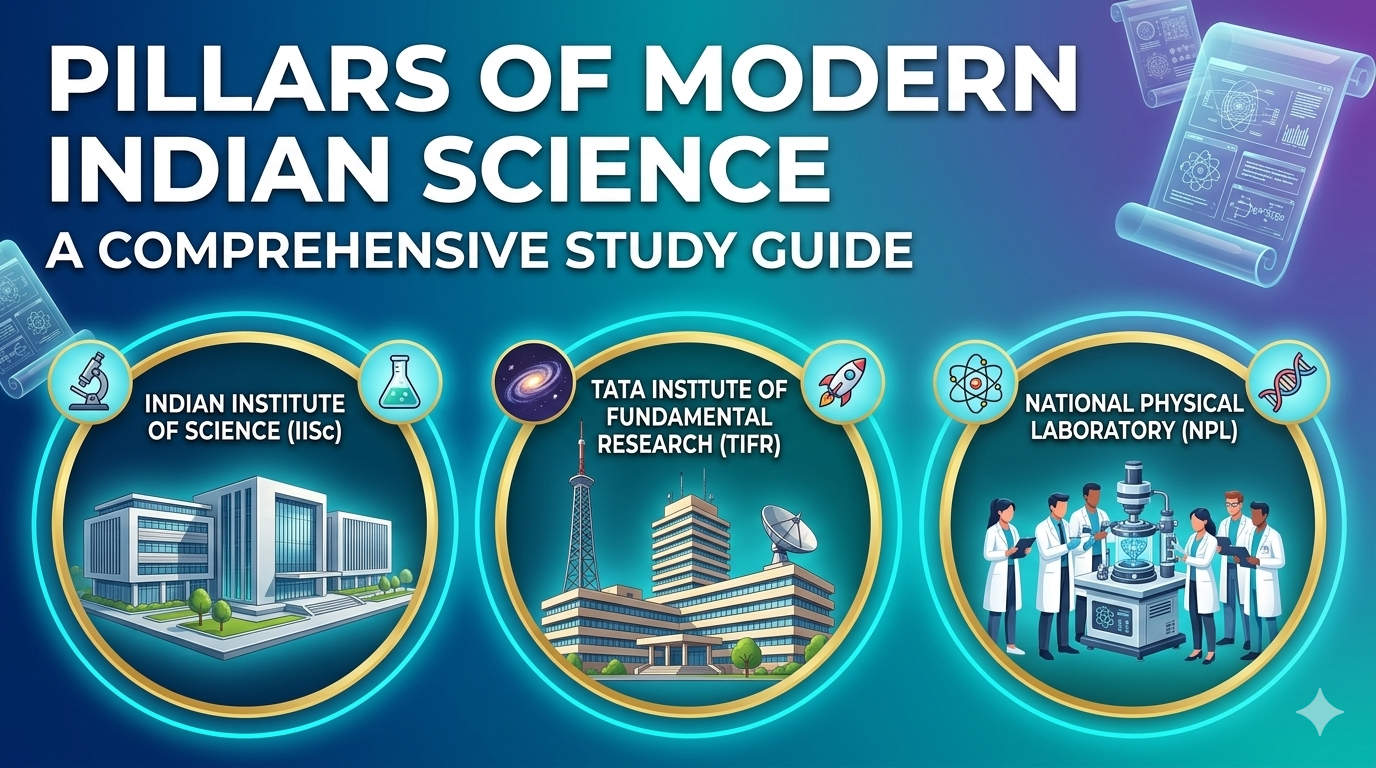
While ancient India laid the philosophical and mathematical foundations of global science, modern India has built a robust, world-class ecosystem of scientific research and innovation. Following independence, visionary leaders like Jawaharlal Nehru, Homi J. Bhabha, and Vikram Sarabhai recognized that national security, economic development, and global standing depended on scientific self-reliance (Atmanirbharta).
This study guide explores the history, establishment, and monumental contributions of India’s most prominent modern scientific institutions: CSIR, ISRO, DRDO, DAE/BARC, and ICAR.
1. CSIR: Council of Scientific and Industrial Research
The Pioneer of Modern Indian Science
Before independence, India lacked a coordinated national framework for industrial research. Recognizing this gap, the Council of Scientific and Industrial Research (CSIR) was established to bridge the gap between laboratory research and industrial application.
- Year of Establishment: 1942 (Started functioning in 1944)
- Key Founders/Visionaries: Arcot Ramasamy Mudaliar (First Director General), with strong advocacy from scientists like Meghnad Saha and Shanti Swarup Bhatnagar.
- Headquarters: New Delhi
- Vision: To provide scientific and technological leadership for India’s industrial, economic, and social development.
Key Contributions & Milestones:
- Network of Labs: CSIR operates a vast network of 37-39 national laboratories across India, making it one of the largest publicly funded R&D organizations in the world.
- Notable Institutes:
- CDRI (Central Drug Research Institute), Lucknow: Developed Centchroman (Saheli), India’s first non-steroidal oral contraceptive.
- NCL (National Chemical Laboratory), Pune: Pioneered research in polymers and sustainable chemistry.
- CFTRI (Central Food Technological Research Institute), Mysuru: Revolutionized food preservation and processing in India.
- CSIR-NEERI: Played a crucial role in developing India’s first indigenous RT-PCR test kits and ventilators during the COVID-19 pandemic.
2. ISRO: Indian Space Research Organisation
Reaching for the Stars with Frugal Innovation
India’s space program is a story of humble beginnings and extraordinary achievements. It was born out of the vision that space technology must be applied to solve real-world problems like communication, weather forecasting, and resource management.
- Precursor: INCOSPAR (Indian National Committee for Space Research), established in 1962 by Dr. Vikram Sarabhai under the guidance of Jawaharlal Nehru.
- Year of Establishment (as ISRO): 1969 (INCOSPAR was renamed and expanded into ISRO).
- Key Founder: Dr. Vikram Sarabhai (widely regarded as the "Father of the Indian Space Program").
- Headquarters: Bengaluru, Karnataka.
- Parent Body: Department of Space (DoS), Government of India.
Key Contributions & Milestones:
- 1975: Launch of Aryabhata, India’s first satellite (launched via a Soviet rocket).
- 1980: Launch of Rohini (RS-1) aboard the SLV-3, making India the 6th country in the world to achieve indigenous satellite launch capability.
- 2008: Chandrayaan-1, India’s first lunar mission, which conclusively discovered water molecules on the Moon.
- 2013: Mangalyaan (Mars Orbiter Mission - MOM). India became the first Asian nation to reach Mars orbit and the first in the world to do so on its maiden attempt, at a record-low cost.
- 2019: Chandrayaan-2 (Orbiter, Lander, Rover). The orbiter continues to send valuable data.
- 2023: Chandrayaan-3 successfully soft-landed near the lunar south pole, making India the first country in the world to achieve this feat.
- Upcoming: Gaganyaan (India’s first human spaceflight mission) and the Bharatiya Antariksha Station (Indian Space Station) by 2035.
3. DRDO: Defence Research and Development Organisation
The Shield of the Nation
A strong defense capability is the bedrock of national sovereignty. DRDO was created to ensure that India’s armed forces are equipped with cutting-edge, indigenous technology, reducing dependence on foreign imports.
- Year of Establishment: 1958
- Formation: Created by merging the Directorate of Technical Development and Production (DTDP) with the Defence Science Organisation (DSO).
- Key Visionaries: Dr. A.P.J. Abdul Kalam (Missile Man of India), Dr. V.K. Saraswat, and numerous other brilliant scientists.
- Headquarters: New Delhi.
- Parent Body: Ministry of Defence, Government of India.
Key Contributions & Milestones:
- Integrated Guided Missile Development Programme (IGMDP): Launched in 1983 under Dr. A.P.J. Abdul Kalam, it gave India a complete suite of missile capabilities:
- Prithvi: Short-range surface-to-surface ballistic missile.
- Agni: Intermediate to intercontinental range ballistic missile.
- Akash: Medium-range surface-to-air missile.
- Nag: Third-generation anti-tank guided missile.
- Trishul: Short-range surface-to-air missile.
- Tejas (LCA): DRDO provided critical technologies (like the flight control system and ejection seat) for India’s indigenous Light Combat Aircraft.
- BrahMos: A joint venture with Russia, producing the world’s fastest supersonic cruise missile.
- Recent Innovations: Development of the Rustom and Nishant UAVs (drones), advanced radar systems, and bulletproof jackets for the armed forces.
4. DAE & BARC: Department of Atomic Energy & Bhabha Atomic Research Centre
Harnessing the Power of the Atom for Peace
India’s nuclear program was uniquely designed not for weapons, but for peaceful energy generation, driven by the visionary physicist Dr. Homi J. Bhabha.
- DAE (Department of Atomic Energy): Established in 1954 under the direct charge of the Prime Minister. Dr. Homi J. Bhabha was its first secretary.
- BARC (Bhabha Atomic Research Centre): Established in 1957 (originally as the Trombay Atomic Energy Establishment, renamed in 1967 after Bhabha’s death).
- Headquarters: Mumbai, Maharashtra.
- Vision: To achieve self-reliance in nuclear technology through a unique Three-Stage Nuclear Power Programme:
- Stage 1: Pressurized Heavy Water Reactors (PHWRs) using natural uranium to produce electricity and Plutonium.
- Stage 2: Fast Breeder Reactors (FBRs) using Plutonium and Uranium-238 to produce more fuel than they consume.
- Stage 3: Advanced reactors using Thorium (which India has in vast reserves) to generate sustainable, long-term energy.
Key Contributions & Milestones:
- Apsara (1956): Asia’s first research nuclear reactor.
- Smiling Buddha (1974): India’s first peaceful nuclear explosive test (Pokhran-I).
- Operation Shakti (1998): Pokhran-II, establishing India as a declared nuclear weapons state.
- Medical Applications: BARC produces a majority of the radioisotopes used in India for cancer diagnosis and treatment (e.g., at hospitals like Tata Memorial).
5. ICAR: Indian Council of Agricultural Research
Feeding a Billion: The Backbone of the Green Revolution
Agriculture is the lifeline of the Indian economy. ICAR is the apex body responsible for coordinating, guiding, and managing research and education in agriculture.
- Year of Establishment: 1929 (Originally as the Imperial Council of Agricultural Research; renamed ICAR in 1966).
- Headquarters: New Delhi.
- Parent Body: Ministry of Agriculture and Farmers Welfare.
- Vision: To promote agricultural research, education, and extension to ensure food and nutritional security.
Key Contributions & Milestones:
- The Green Revolution (1960s): ICAR institutes (like the Indian Agricultural Research Institute - IARI, also known as Pusa Institute) developed high-yielding varieties (HYVs) of wheat (e.g., Kalyan Sona, Sonalika) and rice, transforming India from a food-deficit nation to a food-surplus one.
- White Revolution: Supported dairy research and veterinary sciences that underpinned Operation Flood.
- Network: Operates over 100 research institutes and 71 agricultural universities across India.
- Recent Focus: Climate-resilient crops, bio-fortification (e.g., zinc-rich wheat, iron-rich pearl millet), and sustainable organic farming practices.
6. Premier Educational & Research Hubs: IISc and IITs
Forging the Minds of Tomorrow
While not "research organizations" in the same administrative sense as DRDO or ISRO, these institutions are the primary engines of scientific talent and foundational research in India.
- IISc (Indian Institute of Science):
- Established: 1909 in Bengaluru.
- Founders: Visionary industrialist Jamsetji Tata, with the active support of Swami Vivekananda and the Mysore Maharaja.
- Significance: Consistently ranked as India’s top institution for scientific research and higher learning.
- IITs (Indian Institutes of Technology):
- First IIT: IIT Kharagpur, established in 1951.
- Vision: Championed by India’s first Education Minister, Maulana Abul Kalam Azad, and Prime Minister Jawaharlal Nehru, to create world-class engineering talent for nation-building.
- Significance: Today, there are 23 IITs across India, producing global leaders in technology, research, and entrepreneurship.
📝 Quick Revision Checklist (For Exams & VVM)
|
Institution |
Full Form |
Year of Establishment |
Key Founder / Visionary |
Headquarters |
Notable Achievement / Fact |
|---|---|---|---|---|---|
|
CSIR |
Council of Scientific & Industrial Research |
1942 |
A.R. Mudaliar, S.S. Bhatnagar |
New Delhi |
Developed Saheli (Centchroman); 37+ national labs. |
|
ISRO |
Indian Space Research Organisation |
1969 (INCOSPAR: 1962) |
Dr. Vikram Sarabhai |
Bengaluru |
Chandrayaan-3 (1st to land on Lunar South Pole). |
|
DRDO |
Defence Research & Development Organisation |
1958 |
Dr. A.P.J. Abdul Kalam (Missile Prog.) |
New Delhi |
Agni & Prithvi missiles, BrahMos, Tejas tech. |
|
DAE |
Department of Atomic Energy |
1954 |
Dr. Homi J. Bhabha |
Mumbai |
Three-stage nuclear program (Uranium to Thorium). |
|
BARC |
Bhabha Atomic Research Centre |
1957 (as TAE) |
Dr. Homi J. Bhabha |
Mumbai (Trombay) |
Asia’s first reactor (Apsara, 1956). |
|
ICAR |
Indian Council of Agricultural Research |
1929 |
(Imperial Council) |
New Delhi |
Backbone of India's Green Revolution (HYV seeds). |
|
IISc |
Indian Institute of Science |
1909 |
Jamsetji Tata, Swami Vivekananda |
Bengaluru |
India’s premier institute for advanced scientific research. |
|
IIT |
Indian Institutes of Technology |
1951 (Kharagpur) |
Maulana Abul Kalam Azad, Nehru |
Various (Kharagpur first) |
Premier engineering and technological education. |
💡 Did You Know? (Bonus Facts for Exams)
- ISRO’s Cost Efficiency: The budget for the movie Interstellar was roughly $165 million, while ISRO’s historic Mangalyaan (Mars Orbiter Mission) cost only about $74 million—less than the budget of a Hollywood space movie!
- The Missile Man: Dr. A.P.J. Abdul Kalam’s leadership in the IGMDP earned him the title "Missile Man of India" long before he became the 11th President of India.
- Thorium Reserves: India has the world’s largest reserves of Thorium (about 25% of global reserves), making DAE’s Stage-3 nuclear program a game-changer for India’s long-term energy independence.
A Final Thought for Young Scientists
The story of India’s modern scientific institutions is not just a list of dates and acronyms; it is a testament to the power of vision, perseverance, and self-reliance. From a small sounding rocket launch at Thumba in 1963 to landing on the dark side of the Moon in 2023, Indian scientists have consistently proven that with limited resources and unlimited determination, the sky is not the limit—it is just the beginning.
As you study these institutions, remember that they were built by individuals who were once students just like you. The next great discovery in space, defense, agriculture, or medicine could very well come from your mind.
Keep questioning, keep exploring, and let the legacy of India’s scientific pioneers inspire your journey!
If you found this study guide helpful, bookmark it for your exam revisions! Let us know in the comments which institution you find most fascinating, or if you’d like a deep-dive study guide on India’s modern achievements in Artificial Intelligence, Biotechnology, or Quantum Computing next!
Jai Vigyan! Jai Hind!
Keywords : atomic bhabha council development energy establishment first india indian institute isro key like missile national nuclear research scientific space world
🔔 हमारे YouTube चैनल को सब्सक्राइब करें:
👉 https://www.youtube.com/channel/UC76hj0iZcKkiW1YizHs0n2Q/
📘 Facebook Page:
👉 https://www.facebook.com/DigiTatvaPlus
🌿 वेबसाइट विजिट करें:
👉 https://www.bhaktipulse.com/
👉 https://www.bhaktipulse.com/video
✨ Guest Post Invitation – Share Your Divine Wisdom
🙏 Welcome to BhaktiPulse – your spiritual companion for Aarti, Chalisa, Bhajan, Mantra, and divine stories.
🌸 Do you have spiritual knowledge, devotional content, experiences, or stories that can inspire others?
📖 We warmly invite you to contribute your valuable content and become a part of our growing spiritual community.
✨ Your content may include:
- 🪔 Aarti, Chalisa, Mantra, Bhajan
- 📜 Spiritual stories & life lessons
- 🔍 Unknown facts & scientific reasons in Sanatan Dharma
- 🌿 Ayurveda, rituals, and traditions
💡 If your content aligns with our vision, we will proudly feature it on BhaktiPulse.
📩 Submit your content or contact us here:
👉 https://www.bhaktipulse.com/contact.php
🌼 Let your words spread devotion, ज्ञान, and positivity to the world.
🙏 Join us in this divine journey!
💬 Comments
Approved Comments