The Shakti of Science: A Comprehensive Study Guide to the Women Scientists of India
37 Visited Vidyarthi Vigyan Manthan (VVM) • Updated: Saturday, 18 July 2026
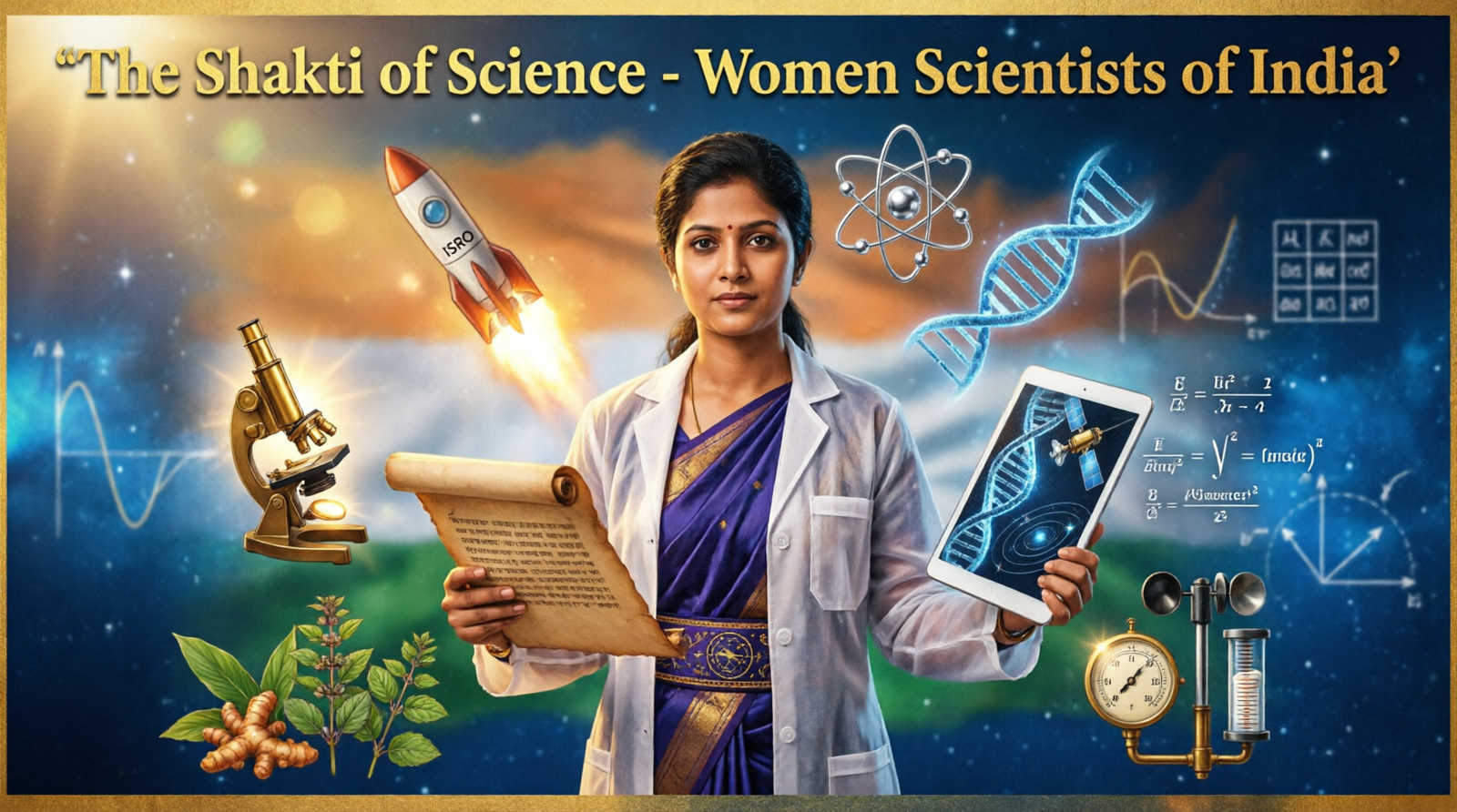
When we think of scientific pioneers in India, names like C.V. Raman, Homi Bhabha, and A.P.J. Abdul Kalam often come to mind. Yet, woven into the very fabric of India’s scientific journey is a powerful, often under-celebrated thread — the extraordinary contributions of its women scientists. From the ancient seers who composed Vedic hymns to the modern researchers decoding the human genome and launching rockets to Mars, Indian women have been at the forefront of scientific discovery, often breaking barriers in a world that told them they didn’t belong.
This comprehensive study guide is designed for students, competitive exam aspirants (VVM, UPSC, NEET, SSC), and science enthusiasts. It chronicles the lives, discoveries, and legacies of India’s most remarkable women scientists across eras and disciplines.
Part 1: The Ancient Pioneers — Women of the Vedas
Long before modern laboratories existed, ancient Indian women were philosophers, mathematicians, and scientists whose intellectual contributions are enshrined in the Vedas and Upanishads.
1. Gargi Vachaknavi (c. 7th Century BCE)
- Field: Philosophy and Cosmology
- Contribution: A renowned philosopher mentioned in the Brihadaranyaka Upanishad. She famously challenged the sage Yajnavalkya in a public debate on the nature of reality, consciousness, and the cosmos. Her probing questions about the fundamental fabric of the universe ("That which is above the sky, beneath the earth, between these two... what is it woven upon?") remain foundational to Indian metaphysical thought.
- Legacy: She is celebrated as one of the earliest known female philosophers in world history, representing the intellectual freedom granted to women in Vedic society.
2. Maitreyi (c. 7th Century BCE)
- Field: Philosophy and Spiritual Science
- Contribution: Another brilliant scholar from the Brihadaranyaka Upanishad, Maitreyi was a Brahmavadini (a female seer of the ultimate reality). When offered worldly wealth by her husband Yajnavalkya, she famously replied, "What shall I do with that which will not make me immortal?" Her dialogue on the nature of the Atman (Self) is a cornerstone of Vedantic philosophy.
- Legacy: A symbol of the pursuit of knowledge over material wealth.
3. Lopamudra (c. Vedic Period)
- Field: Vedic Literature and Mantra Composition
- Contribution: A revered seer who composed hymns in the Rigveda (Mandala 1, Hymn 179). She is also associated with the esoteric science of the Lalita Sahasranama in some traditions.
- Legacy: Proof that women in ancient India were not merely passive listeners but active creators of sacred and scientific knowledge.
4. Ghosha, Apala, and Vishwavara
- Field: Vedic Science and Medicine
- Contribution: These Rigvedic seers composed hymns related to health, nature, and cosmic order. Apala, for instance, is credited with early observations on plant physiology and is sometimes regarded as a proto-botanist.
Part 2: The Modern Pioneers — Breaking Colonial and Patriarchal Barriers
The late 19th and early 20th centuries saw Indian women fight a dual battle — against colonial rule and against deeply entrenched patriarchal norms — to claim their place in science and medicine.
5. Dr. Anandibai Joshi (1865–1887)
- Title: First Indian Woman Physician with a Western Medical Degree
- Key Contribution: Married at the age of 9, she defied convention to pursue medicine. She earned her M.D. in Medicine from the Women’s Medical College of Pennsylvania in 1886, becoming one of the first Indian women to study and practice Western medicine.
- Legacy: She pioneered the path for thousands of Indian women in medicine. Her short life (she died at 21 from tuberculosis) is a testament to her extraordinary courage.
6. Dr. Muthulakshmi Reddi (1886–1968)
- Title: First Female Legislator in British India; Pioneer in Cancer Care
- Key Contribution:
- First woman student admitted to the Madras Medical College (1907).
- Appointed to the Madras Legislative Council (1927), where she fought against the Devadasi system and child marriage.
- Founded the Adyar Cancer Institute in 1954, one of India’s premier cancer research and treatment centers.
- Legacy: A triple pioneer — in medicine, politics, and social reform.
7. Dr. Kamala Ranadive (1921–2010)
- Title: Pioneer of Cancer Research in India
- Field: Cancer Biology and Experimental Pathology
- Key Contribution:
- First woman to earn a D.Sc. in Science from Bombay University.
- Demonstrated experimentally that breast cancer could be induced in mice through hormonal stimulation, a groundbreaking discovery in the 1960s.
- Her work at the Indian Cancer Research Centre (ICRC) laid the foundation for modern cancer research in India.
- Major Awards: Padma Shri (1965), INSA Fellow.
Part 3: The Mid-Century Titans — Building Independent India’s Scientific Infrastructure
These women scientists joined India’s scientific institutions in the decades following independence, shaping the nation’s research landscape.
8. Dr. Asima Chatterjee (1917–2006)
- Title: Pioneer of Phytomedicine
- Field: Organic Chemistry, Phytochemistry
- Key Contribution:
- First woman in India to earn a D.Sc. (1944, University of Calcutta).
- Isolated the alkaloid Reserpine from Rauvolfia serpentina (Sarpagandha), revolutionizing hypertension treatment.
- Conducted landmark research on Vinca rosea alkaloids for anti-cancer drugs.
- Co-authored the monumental six-volume The Indian Medicinal Plants.
- Major Awards: Shanti Swarup Bhatnagar Prize (1961), Padma Bhushan (1975), Fellow of the Royal Society of Edinburgh (first Indian woman).
9. Dr. Anna Mani (1918–2020)
- Title: The Weather Woman of India
- Field: Physics, Meteorology
- Key Contribution:
- Designed and manufactured over 200 meteorological instruments, making India self-reliant in weather instrumentation.
- Established India’s nationwide solar radiation observatory network.
- Pioneered atmospheric ozone measurements in India.
- Authored the classic Solar Radiation over India (1981).
- Major Awards: Padma Bhushan (1987).
- Remarkable Fact: Lived to be 102 years old, witnessing India’s journey from colonial rule to a space-faring nation.
10. Dr. Janaki Ammal (1897–1984)
- Title: Lady of the Plants
- Field: Cytogenetics, Ethnobotany
- Key Contribution:
- Conducted groundbreaking research on sugarcane breeding, developing high-yielding, disease-resistant varieties that transformed India’s sugar industry.
- Worked on the cytogenetics of Datura and Solanum species.
- Documented the ethnobotany of medicinal plants in the Nilgiris.
- Co-authored the Chromosome Atlas of Cultivated Plants.
- Major Awards: Padma Shri (1977).
11. Dr. Kamala Sohonie (1911–1998)
- Title: First Indian Woman PhD in a Scientific Discipline
- Field: Biochemistry
- Key Contribution:
- First Indian woman to earn a Ph.D. in Science (from Cambridge University, 1939, under Sir Frederick Gowland Hopkins, a Nobel laureate).
- Discovered the enzyme Cytochrome C in horse muscle tissue (independently of other researchers).
- Conducted pioneering research on Neera (palm sap), proving it to be a rich, affordable source of nutrition that could combat rural malnutrition.
- Legacy: Battled institutional sexism to gain admission to the Baroda University chemistry department and later became its first female professor.
12. Dr. Darshan Ranganathan (1938–2020)
- Title: Queen of Organic Synthesis
- Field: Organic Chemistry
- Key Contribution:
- A world-renowned expert in organic synthesis, particularly in the synthesis of complex natural products and insect pheromones.
- Developed novel synthetic routes for insect pheromones, which became eco-friendly alternatives to chemical pesticides.
- Held several international patents.
- Major Awards: Padma Shri (1988), INSA Fellow, TWAS Fellow.
- Remarkable Fact: She and her husband, Dr. Nitya Ranganathan, were one of India’s most celebrated scientific couples, often co-authoring papers.
Part 4: The Modern Trailblazers — Leading India into the 21st Century
These contemporary women scientists are at the cutting edge of space, defense, medicine, and biotechnology.
13. Dr. Tessy Thomas (Born 1963)
- Title: Missile Woman of India
- Field: Defense Technology, Missile Systems
- Key Contribution:
- First woman scientist to head a major missile project in India.
- Project Director for the Agni-IV intermediate-range ballistic missile.
- Played a crucial role in the development of the Agni-V ICBM.
- Major Awards: Lal Bahadur Shastri National Award, DRDO Scientist of the Year.
- Legacy: Broke the glass ceiling in India’s highly secretive, male-dominated defense research ecosystem.
14. Dr. Ritu Karidhal (Born 1975)
- Title: Woman of Mars
- Field: Space Science, Aerospace Engineering
- Key Contribution:
- Deputy Operations Director of ISRO’s historic Mangalyaan (Mars Orbiter Mission) in 2014.
- Played a pivotal role in the successful Chandrayaan-2 mission.
- Currently serving as the Executive Director of the Uttar Pradesh Space Promotion and Authorization Centre (UPSPARC).
- Legacy: Her leadership in India’s first interplanetary mission inspired a generation of young girls to look at the stars.
15. Dr. Nandini Harinath
- Title: Rocket Woman of India
- Field: Aerospace Engineering
- Key Contribution:
- Served as the Deputy Director of the Navigation Systems for ISRO’s Mangalyaan mission.
- Instrumental in developing the navigation and guidance systems that ensured the spacecraft’s precise orbit around Mars.
- Legacy: A key figure behind the technical success of India’s Mars mission.
16. Dr. Mangala Mani
- Title: Astrophysicist and Educator
- Field: Astrophysics, High-Energy Physics
- Key Contribution:
- A leading authority on X-ray astronomy and the study of black holes and neutron stars.
- Served as the Head of the Department of Physics and Astrophysics at the University of Delhi.
- Instrumental in India’s participation in international astrophysics collaborations.
- Legacy: Mentored generations of students and advocated strongly for women in science.
17. Dr. Gagandeep Kang (Born 1962)
- Title: Pioneer of Indian Virology
- Field: Virology, Clinical Research
- Key Contribution:
- First Indian woman to be elected a Fellow of the Royal Society (FRS) in 2023 — one of the highest scientific honors in the world.
- Conducted groundbreaking research on rotavirus, leading to the development of India’s first indigenous rotavirus vaccine (Rotavac), which saves thousands of children’s lives annually.
- Leading researcher on enteric infections and vaccine development.
- Major Awards: Fellow of the Royal Society (2023), TWAS Prize, Shanti Swarup Bhatnagar Prize.
18. Dr. Soumya Swaminathan (Born 1959)
- Title: Global Health Leader
- Field: Pediatrics, Clinical Research, Public Health
- Key Contribution:
- Served as the Chief Scientist of the World Health Organization (WHO) (2019–2022).
- Previously served as the Director General of the Indian Council of Medical Research (ICMR).
- Played a pivotal role in global research on HIV/AIDS, tuberculosis, and malaria.
- Led India’s response during the COVID-19 pandemic as a key scientific advisor.
- Major Awards: Padma Shri (2013).
- Legacy: One of the most influential Indian women in global health policy.
19. Dr. Chandrima Shaha
- Title: Cell Biology Pioneer
- Field: Cell Biology, Parasitology
- Key Contribution:
- A leading researcher on Leishmaniasis (Kala-azar), a deadly tropical disease.
- Discovered how the Leishmania parasite survives inside human macrophages, opening new avenues for drug development.
- Served as the President of the Indian National Science Academy (INSA) — a rare honor for a woman.
- Major Awards: Shanti Swarup Bhatnagar Prize, TWAS Prize, INSA Medal.
20. Dr. Jayanthi Banerji
- Title: Cancer Research Pioneer
- Field: Cancer Biology, Cell Signaling
- Key Contribution:
- Discovered the role of the p53 tumor suppressor gene in Indian cancers, contributing to the global understanding of cancer genetics.
- Her work at the National Centre for Cell Science (NCCS), Pune, has been instrumental in developing new cancer therapies.
- Major Awards: Shanti Swarup Bhatnagar Prize, TWAS Prize.
21. Dr. Swati Nayak
- Title: Malaria Researcher
- Field: Malariology, Drug Development
- Key Contribution:
- Leads malaria drug development at PATH, a global health organization.
- Instrumental in the development of new anti-malarial drugs targeting drug-resistant strains of Plasmodium falciparum.
- Her work is critical in the global fight against malaria, which still kills hundreds of thousands annually.
22. Prof. Rohini Godbole (1952–2024)
- Title: Trailblazer of Particle Physics
- Field: Theoretical High-Energy Physics
- Key Contribution:
- Pioneering work on the Higgs Boson and Supersymmetry, providing theoretical frameworks that aided CERN’s experimental discoveries.
- Co-edited Lilavati’s Daughters: The Women Scientists of India (2008), a landmark book documenting the contributions of Indian women in science.
- A fierce advocate for gender equity in STEM.
- Major Awards: Padma Shri (2019), Ordre National du Mérite (France, 2021), Infosys Prize (2009).
Part 5: The Emerging Generation — New Voices in Indian Science
23. Dr. Sunita Solomon
- Field: HIV/AIDS Research
- Key Contribution:
- Founded the Y.R. Gaitonde Centre for AIDS Awareness in Chennai.
- Pioneered prevention of parent-to-child transmission of HIV in India.
- Her work has saved countless lives and transformed India’s HIV response.
24. Dr. Mitali Mukerji
- Field: Genomics
- Key Contribution:
- Leading researcher at CSIR-IGIB working on the Indian Genome Variation project.
- Pioneered research on the genetic basis of diseases specific to Indian populations.
25. Dr. Aswathy Nair
- Field: Space Science
- Key Contribution:
- A young scientist at ISRO working on advanced satellite communication systems.
- Represents the new generation of women engineers powering India’s space ambitions.
📝 Quick Revision Checklist (For Exams & VVM)
|
Scientist |
Field |
Key Contribution |
Major Recognition |
|---|---|---|---|
|
Gargi Vachaknavi |
Vedic Philosophy |
Debated Yajnavalkya on cosmology |
Brihadaranyaka Upanishad |
|
Anandibai Joshi |
Medicine |
First Indian woman with Western MD |
MD from Pennsylvania (1886) |
|
Muthulakshmi Reddi |
Medicine / Politics |
First female legislator; founded Adyar Cancer Institute |
Padma Bhushan |
|
Kamala Ranadive |
Cancer Research |
Induced breast cancer in mice via hormones |
Padma Shri (1965) |
|
Asima Chatterjee |
Organic Chemistry |
Isolated Reserpine; The Indian Medicinal Plants |
Padma Bhushan (1975), S.S. Bhatnagar |
|
Anna Mani |
Meteorology |
Designed 200+ weather instruments |
Padma Bhushan (1987) |
|
Janaki Ammal |
Cytogenetics |
Sugarcane breeding; Chromosome Atlas |
Padma Shri (1977) |
|
Kamala Sohonie |
Biochemistry |
First Indian woman PhD in science; Cytochrome C |
Cambridge PhD (1939) |
|
Darshan Ranganathan |
Organic Chemistry |
Insect pheromone synthesis |
Padma Shri (1988) |
|
Tessy Thomas |
Defense |
Project Director, Agni-IV |
Missile Woman of India |
|
Ritu Karidhal |
Space |
Deputy Ops Director, Mangalyaan |
Woman of Mars |
|
Nandini Harinath |
Space |
Navigation systems, Mangalyaan |
Rocket Woman of India |
|
Mangala Mani |
Astrophysics |
X-ray astronomy, black holes |
University of Delhi |
|
Gagandeep Kang |
Virology |
Rotavirus vaccine (Rotavac) |
Fellow of Royal Society (2023) |
|
Soumya Swaminathan |
Public Health |
WHO Chief Scientist; ICMR DG |
Padma Shri (2013) |
|
Chandrima Shaha |
Cell Biology |
Leishmaniasis research |
INSA President |
|
Jayanthi Banerji |
Cancer Biology |
p53 gene in Indian cancers |
S.S. Bhatnagar Prize |
|
Swati Nayak |
Malariology |
Anti-malarial drug development |
PATH |
|
Rohini Godbole |
Particle Physics |
Higgs Boson theory; Lilavati’s Daughters |
Padma Shri (2019) |
💡 Did You Know? (Bonus Facts for Exams)
- The Royal Society Milestone: In 2023, Gagandeep Kang became the first Indian woman elected as a Fellow of the Royal Society (FRS) — the world’s oldest scientific academy, founded in 1660. This is a historic recognition of Indian women in global science.
- A Century of Weather: Anna Mani lived for 102 years (1918–2020). She witnessed India’s first rocket launch in 1963, the first satellite in 1975, and the Mars mission in 2014 — spanning nearly every milestone of India’s scientific journey.
- The Lilavati Connection: Rohini Godbole named her landmark book Lilavati’s Daughters after the 12th-century math text by Bhaskara II, who wrote it for his daughter. It symbolizes the unbroken lineage of Indian women in science.
- The Unpatented Legacy: Like J.C. Bose, several early women scientists (including Muthulakshmi Reddi) prioritized public service over patents, ensuring their discoveries benefited society rather than private profit.
- A Couple of Scientists: Darshan and Nitya Ranganathan were one of India’s most celebrated scientific couples, co-authoring papers and jointly advancing organic chemistry.
- From Milk to Missiles to Mars: India’s scientific story features women at every level — from Verghese Kurien’s dairy revolution to Tessy Thomas’s missiles to Ritu Karidhal’s Mars mission.
Part 6: Challenges and Triumphs — The Road Ahead
Historical Challenges:
- Educational Barriers: Until the early 20th century, women were largely excluded from formal science education.
- Institutional Sexism: Pioneers like Kamala Sohonie had to fight for admission to universities and research labs.
- Work-Life Balance: Many women scientists faced societal pressure to prioritize family over career.
- Under-Representation: Women remain under-represented in leadership positions in science, despite strong participation at the student level.
Government Initiatives for Women in Science:
- KIRAN (Knowledge Involvement in Research Advancement through Nurturing): DST program to support women scientists.
- Women Scientists Scheme (WOS-A, WOS-B, WOS-C): For women re-entering science after career breaks.
- VAJRA-Vidushi: For women researchers in academia.
- Genome Valley S&T Program: Encouraging girls in STEM at the school level.
The Road Ahead:
India ranks relatively well globally in the percentage of women in scientific research (about 28% of researchers are women, higher than many developed nations). However, the challenge remains in ensuring equal representation in leadership, equal pay, and equal access to research funding.
A Final Thought for Young Scientists
The story of India’s women scientists is a story of quiet revolution. They did not always seek the spotlight, but their work illuminated the path for millions. From Gargi questioning the cosmos under a banyan tree, to Ritu Karidhal guiding a spacecraft to Mars, these women have shown that curiosity knows no gender, and that the pursuit of knowledge is the most powerful form of freedom.
When you open a textbook, look at a weather forecast, take a vaccine, or watch a rocket launch — remember that behind many of these achievements stands a woman who refused to be told she couldn’t.
Let their legacy remind you: Science is not a man’s world. It is humanity’s world. And you — regardless of who you are — belong in it.
Keywords : cancer contribution field first her india indian key legacy major padma research science scientific scientists she that title woman women
🔔 हमारे YouTube चैनल को सब्सक्राइब करें:
👉 https://www.youtube.com/channel/UC76hj0iZcKkiW1YizHs0n2Q/
📘 Facebook Page:
👉 https://www.facebook.com/DigiTatvaPlus
🌿 वेबसाइट विजिट करें:
👉 https://www.bhaktipulse.com/
👉 https://www.bhaktipulse.com/video
✨ Guest Post Invitation – Share Your Divine Wisdom
🙏 Welcome to BhaktiPulse – your spiritual companion for Aarti, Chalisa, Bhajan, Mantra, and divine stories.
🌸 Do you have spiritual knowledge, devotional content, experiences, or stories that can inspire others?
📖 We warmly invite you to contribute your valuable content and become a part of our growing spiritual community.
✨ Your content may include:
- 🪔 Aarti, Chalisa, Mantra, Bhajan
- 📜 Spiritual stories & life lessons
- 🔍 Unknown facts & scientific reasons in Sanatan Dharma
- 🌿 Ayurveda, rituals, and traditions
💡 If your content aligns with our vision, we will proudly feature it on BhaktiPulse.
📩 Submit your content or contact us here:
👉 https://www.bhaktipulse.com/contact.php
🌼 Let your words spread devotion, ज्ञान, and positivity to the world.
🙏 Join us in this divine journey!
💬 Comments
Approved Comments