Traditional Knowledge Systems of Ancient India: A Comprehensive Study Guide to Water Harvesting, Agriculture, and Shipbuilding
34 Visited Vidyarthi Vigyan Manthan (VVM) • Updated: Saturday, 18 July 2026
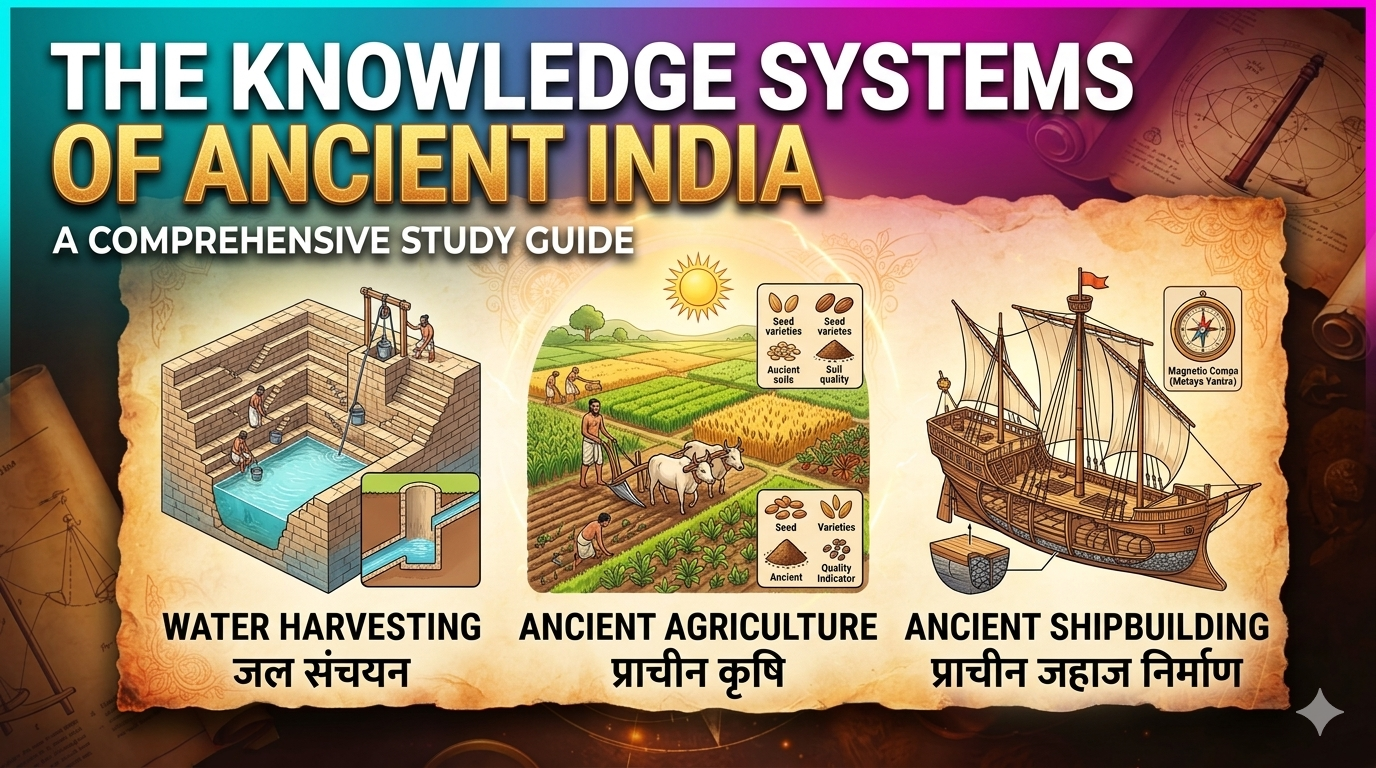
Ancient India was not merely a land of spiritual wisdom and philosophical thought; it was also a cradle of sophisticated scientific and technological systems that sustained one of the world's oldest continuous civilizations. Long before modern engineering, the people of ancient India developed highly refined, region-specific solutions to the challenges of water management, food production, and maritime trade.
These systems were not random inventions but evolved over millennia through careful observation of nature, deep ecological understanding, and systematic documentation in Sanskrit texts. This study guide explores three remarkable pillars of ancient Indian traditional knowledge: Water Harvesting Systems, Agricultural Practices, and Shipbuilding Technology.
1. Jal Sanchayan: Ancient Indian Water Harvesting Systems
Water is the foundation of civilization. Ancient Indian scholars recognized this truth profoundly. The Arthashastra of Kautilya (c. 3rd Century BCE) explicitly states that the king must ensure the construction of new waterworks and the maintenance of old ones. The Vedas, particularly the Rigveda, contain hymns celebrating the sanctity and life-giving power of water.
Ancient Indian water harvesting was not merely about storing water; it was a sophisticated science of catchment management, groundwater recharge, micro-climate regulation, and community-based governance.
1.1 The Philosophy Behind Water Conservation
Ancient Indian texts treated water as a sacred element (Jala Tattva) and recognized the hydrological cycle intuitively. The principle was simple yet profound: "Slow it, spread it, sink it" — meaning rainwater should be slowed down, spread across the landscape, and allowed to percolate into the ground rather than rushing away as destructive runoff.
The Brihat Samhita of Varahamihira (6th Century CE) contains detailed chapters on site selection for water bodies, soil testing, and the identification of underground water sources using indicator plants and termite mounds.
1.2 Regional Water Harvesting Systems
India's diverse geography gave rise to remarkably diverse water harvesting systems, each adapted to local rainfall patterns, topography, and soil conditions.
A. Stepwells (Vavs / Baolis) — Western India (Gujarat & Rajasthan)
- Structure: Deep, architecturally magnificent wells with stepped access, reaching down to the groundwater table.
- Notable Examples:
- Rani ki Vav, Patan (Gujarat): Built in the 11th century by Queen Udayamati, this UNESCO World Heritage Site is over 64 meters deep with seven levels of intricately carved sculptures.
- Chand Baori, Abhaneri (Rajasthan): A 10th-century stepwell with 3,500 narrow steps arranged in perfect geometric symmetry, descending 30 meters.
- Scientific Principle: Stepwells served dual purposes — they provided year-round access to groundwater during dry seasons and acted as cool community gathering spaces, with temperatures 5-6°C lower than surface levels.
B. Johads and Khadins — Rajasthan (Arid Zones)
- Johads: Small, earthen check dams that capture monsoon rainwater, allowing it to percolate and recharge groundwater. A chain of johads in a watershed could transform an entire region's water table.
- Khadins: Long earthen embankments built across slopes to impede runoff, allowing water to stand and seep into the soil. The deposited silt enriched the soil, enabling agriculture even in arid regions.
- Modern Revival: The legendary work of Rajendra Singh (the "Waterman of India") in Rajasthan's Alwar district revived thousands of johads, bringing rivers like the Arvari back to life and earning him the Stockholm Water Prize (2015).
C. Ahar-Pyne Systems — Bihar (Eastern Plains)
- Structure: Ahars are rectangular embankments that capture rainwater runoff, while Pynes are diversion channels that carry river water into the ahars.
- Scientific Principle: This system created a cascade of water bodies that not only irrigated fields but also recharged groundwater and supported fisheries. The silt deposited in ahars was later used as nutrient-rich manure.
D. Surangams and Karez — Western Ghats & Arid North
- Surangams (Kerala/Karnataka): Horizontal tunnels dug into laterite hillsides to tap into groundwater seepage. The water gently flows out by gravity, providing a perennial water source without evaporation losses.
- Karez/Kuhl Systems (Himachal & Kashmir): Underground channels that transport water from mountain springs to villages, similar to the Persian qanat system but adapted to Himalayan geology.
E. Tank Systems (Eris) — Tamil Nadu & South India
- Structure: Massive cascading tank systems built across river valleys. South India has over 40,000 ancient tanks, many dating back to the Chola, Pandya, and Pallava dynasties (3rd Century BCE onwards).
- Notable Examples: The Grand Anicut (Kallanai) built by Karikala Chola (c. 2nd Century CE) across the Kaveri River is one of the oldest water-regulation structures in the world, still in use today.
- Scientific Principle: Tank cascades were designed so that overflow from one tank fed the next, maximizing water use, preventing flooding, and recharging groundwater across entire river basins.
F. Zabo and Phad Systems — Maharashtra
- Zabo: A combination of forest conservation, water storage, and agriculture. Rainwater from forested hilltops is captured in mid-slope ponds and used for downstream paddy cultivation.
- Phad: Community-managed irrigation systems along the Tapi and Narmada rivers using temporary check dams.
1.3 Ancient Texts on Water Management
- Arthashastra (Kautilya): Chapter 2.25 details the Superintendent of Waterworks (Kupyadhyaksha) and prescribes penalties for damaging water infrastructure.
- Brihat Samhita (Varahamihira): Chapters on Darakargadhya (well-digging) and water source identification.
- Kashyapiyakrishisukti: Contains references to irrigation and water management in agriculture.
1.4 Modern Relevance
With India facing its worst water crisis in history — 21 cities projected to run out of groundwater by 2030 (NITI Aayog report) — these ancient systems offer proven, sustainable solutions. The Jal Shakti Abhiyan and Atal Bhujal Yojana are modern government initiatives that explicitly draw inspiration from traditional water harvesting wisdom.
2. Krishi Paddhati: Ancient Indian Agricultural Practices
India's agricultural civilization is one of the oldest in the world, with evidence of organized farming dating back to the Indus Valley Civilization (c. 3300–1300 BCE), where wheat, barley, and cotton were cultivated. However, it was in the later Vedic and classical periods that agricultural science was systematically codified.
2.1 Ancient Agricultural Texts (Krishi Shastra)
Several Sanskrit texts dedicated entirely to agriculture have survived, revealing a highly scientific approach to farming:
- Krishi-Parashara (c. 400 BCE): Attributed to the sage Parashara, this is one of the oldest known agricultural treatises. It discusses ploughing, soil types, seed selection, crop protection, and the economic aspects of farming.
- Kashyapiyakrishisukti (c. 8th–10th Century CE): A comprehensive text covering land classification, manure preparation, irrigation, and livestock management.
- Lokopakara (1025 CE): Written by Chavundaraya, this Kannada text covers agriculture, horticulture, medicine, and divination.
- Supashastra and Vrikshayurveda by Surapala (c. 10th Century CE): A remarkable text on plant science, describing diseases of plants, their diagnosis, and treatment using natural remedies — essentially ancient plant pathology.
- Krishisuktisara and various sections of the Brihat Samhita dealing with agriculture.
2.2 Soil Classification (Bhumi Pariksha)
Ancient Indian farmers had a sophisticated understanding of soil science. The Krishi-Parashara classifies soils based on:
- Color: Black, red, yellow, white, pale (each indicating different mineral content)
- Texture: Sandy (Bhumi), clayey (Mruttika), loamy (Sharkara)
- Taste and Smell: Used as indicators of fertility
- Water Retention Capacity: Critical for crop selection
They understood that different crops thrived in different soils and practiced soil testing by observing the vegetation naturally growing on a plot before deciding what to cultivate.
2.3 Agricultural Tools and Implements
Ancient Indian agriculture used a range of sophisticated tools:
- Siryam (Plough): Made of strong wood like Khadir or Khair, with iron tips. The Krishi-Parashara describes different plough types for different soils.
- Kunapa (Weeder): For removing weeds without damaging crops.
- Datra (Sickle): For harvesting.
- Musala (Pestle) and Khalva (Mortar): For processing grains.
- Chakram (Water wheel): Used for lifting water from wells, described in texts as Araghatta.
2.4 Irrigation Methods (Setubandha & Nali-Jal)
Ancient texts describe four primary sources of irrigation:
- Deva (Rain) — considered the most natural
- Nadi (Rivers and canals)
- Kupa (Wells)
- Tadaga (Tanks and reservoirs)
Methods of water lifting included:
- Droni: A leather bucket lifted by humans or animals
- Araghatta: The Persian wheel or water wheel, documented in Indian texts
- Shadoof/Swung Basket: A simple lever-based device for lifting water
2.5 Manure and Soil Fertility (Khadira)
Ancient Indian farmers were masters of organic farming, millennia before the modern organic movement:
- Green Manuring: Growing specific plants (like dhaincha/sesbania) and ploughing them back into the soil.
- Animal Manure: Cow dung, sheep droppings, and compost were systematically used.
- Oil Cakes: Residue from oil extraction (like neem cake) was used both as fertilizer and pest repellent.
- Bio-fertilizers: The use of specific bacterial cultures (though not understood microbiologically) was practiced through traditional methods like soaking seeds in cow dung slurry.
2.6 Crop Rotation and Mixed Cropping
Ancient farmers understood the principles of crop rotation to maintain soil fertility:
- Legume Cereals Rotation: Alternating nitrogen-fixing legumes (pulses) with cereals (wheat, rice) to naturally replenish soil nitrogen.
- Mixed Cropping (Samvalan): Growing multiple crops together (like the famous Three Sisters of maize, beans, and squash in other cultures, India had similar systems with millets, pulses, and oilseeds).
- Fallow Periods: Leaving land uncultivated for a season to recover its fertility.
2.7 Pest Management (Kriminashak)
The Vrikshayurveda of Surapala describes numerous natural pest control methods:
- Neem-based preparations: Neem leaves, oil, and cake were used as powerful insect repellents.
- Cow urine sprays: Used as fungicides and insecticides.
- Ash and lime: Applied to protect stored grains and growing crops.
- Companion planting: Certain plants were grown together to repel pests naturally.
- Biological control: Encouraging natural predators like certain birds and insects.
2.8 Seed Treatment and Storage
- Seed Treatment: Seeds were treated with cow dung, ash, and herbal extracts before sowing to prevent fungal infections and enhance germination.
- Granaries (Koshthagara): Ancient granaries were built with raised platforms, ventilated walls, and treated with neem leaves and turmeric to protect grains from pests and moisture. The Great Granary of Mohenjo-daro (c. 2500 BCE) is one of the earliest examples of sophisticated grain storage.
2.9 Notable Crops Indigenous to India
Ancient India domesticated and cultivated numerous crops that now feed the world:
- Cotton (Karpasa): India was the first to cultivate cotton (Indus Valley, c. 3000 BCE).
- Sugarcane (Ikshu): The word "sugar" itself derives from Sanskrit Sharkara.
- Rice (Vrihi): Cultivated in the Ganges plains since at least 6000 BCE.
- Millets, Pulses, Spices: Including turmeric, black pepper, cardamom, and ginger.
2.10 Modern Relevance
With the environmental costs of the Green Revolution (soil degradation, groundwater depletion, pesticide resistance), there is a global resurgence of interest in ancient Indian agricultural practices. The Paramparagat Krishi Vikas Yojana (PKVY) and Zero Budget Natural Farming (ZBNF) movements explicitly draw from these traditional wisdom systems.
3. Jahaj Nirman Kala: Ancient Indian Shipbuilding and Marine Technology
Perhaps the most surprising aspect of ancient Indian technology is its sophisticated maritime tradition. Long before European exploration, Indian ships were navigating the Indian Ocean, trading with Rome, Southeast Asia, China, and even possibly the Americas.
3.1 Archaeological Evidence
- Lothal Dockyard (c. 2400 BCE): Located in Gujarat, this is the world's earliest known tidal dockyard. Built during the Indus Valley Civilization, it was a massive brick-lined basin (37m x 22m) connected to an ancient course of the Sabarmati River. Ships could enter during high tide and be serviced during low tide — a feat of hydraulic engineering that amazes modern engineers.
- Balita/Baluchar Ports: Ancient ports along the western coast mentioned in Greek and Roman texts.
- Arikamedu (Tamil Nadu): A major Roman trading port with archaeological evidence of Mediterranean amphorae, Roman coins, and Indian exports.
3.2 Ancient Texts on Shipbuilding
- Yukti Kalpataru (c. 11th Century CE): Attributed to King Bhoja of Paramara dynasty, this is the most comprehensive ancient Indian text on shipbuilding. It describes:
- Different types of ships for various purposes (riverine, coastal, oceanic)
- Materials selection (specific woods for different ship parts)
- Construction techniques
- Decorative and functional aspects
- Samarangana Sutradhara (c. 11th Century CE): Also by King Bhoja, this encyclopedic work contains detailed chapters on naval architecture.
- Arthashastra: Chapter 2.30 mentions the Navadhyaksha (Superintendent of Ships), indicating state regulation of maritime activities.
- Manasollasa (12th Century CE): By King Someshvara III of the Chalukya dynasty, contains references to ship construction.
3.3 Types of Ships (Navas)
Ancient Indian texts classify ships into numerous categories based on size, purpose, and design:
By Size:
- Apatya: Small boats for river crossing
- Madhyama: Medium-sized vessels for coastal trade
- Vimana: Large ocean-going ships (the term later came to mean "flying chariot" in epics, reflecting the awe these vessels inspired)
By Purpose:
- Yuddha Nava: Warships, armed with battering rams and archers
- Vyapara Nava: Merchant vessels for trade
- Dharma Nava: Ships for pilgrimage and religious voyages
Special Designs:
- Chitra Nava: Decorated ships for royal processions
- Pata Nava: Ships with specific hull designs for speed
- Tira Nava: Ferries and crossing boats
3.4 Materials and Construction Techniques
Ancient Indian shipbuilders had deep knowledge of materials science:
- Wood Selection:
- Teak (Sagwan): Preferred for hulls due to its natural resistance to water and marine borers.
- Rosewood (Taamala): Used for structural components.
- Sandalwood, Ebony: For decorative and specialized parts.
- Bamboo: Used for smaller vessels and rafts.
- Construction Methods:
- Mortise and Tenon Joints: Wooden planks were joined using precisely carved joints without iron nails, making the ships flexible and resistant to storm damage.
- Stitched Boats: In South India and the Maldives, boats were traditionally stitched with coir rope rather than nailed — a technique that produced flexible hulls ideal for navigating coral reefs.
- Waterproofing: Hulls were coated with a mixture of fish oil, lime, and tree resin (similar to modern marine paint) to prevent leakage and wood rot.
- Innovative Features:
- Compartmentalization: Large ships had multiple watertight compartments — a principle that European shipbuilders only adopted in the 18th century.
- Double Hulls: For ocean-going vessels, providing extra protection.
- Multiple Masts: Large ships had several masts with sails made of cotton or palm leaf fiber.
3.5 Navigation Techniques
Ancient Indian navigators were masters of the seas, using sophisticated techniques:
- Stellar Navigation: Using the positions of stars, particularly the Dhruva Tara (Pole Star), for direction finding. The word "navigation" itself derives from Sanskrit Nav (ship) + Gatih (movement).
- Wind Pattern Knowledge: Detailed understanding of the monsoon winds — the southwest monsoon (June-September) and northeast monsoon (October-December) — which were used to sail across the Indian Ocean predictably.
- Magnetic Compass: There is evidence that ancient Indians used early forms of magnetic compasses, with the Matsya Yantra (Fish Instrument) described in texts being a possible precursor.
- Coastal Piloting: Detailed knowledge of coastlines, landmarks, and water depths passed down through generations of sailors.
3.6 Maritime Trade and Global Connections
Ancient Indian ships connected India to the world in a vast trade network:
- Roman Trade (1st–3rd Century CE): Indian spices, textiles, gems, and steel were exported to Rome. Roman historian Pliny the Elder complained that Rome was being drained of gold to pay for Indian luxuries.
- Southeast Asian Colonization: Indian traders and scholars established kingdoms across Southeast Asia — the Champa kingdom in Vietnam, Srivijaya in Indonesia, Majapahit, and the Khmer Empire in Cambodia (builders of Angkor Wat). This cultural expansion was called Greater India or Suvarnabhumi.
- Chinese Trade: Indian ships regularly traded with China, bringing Buddhist texts, spices, and textiles. The famous Chinese pilgrim Fa-Hien returned to China on an Indian ship in the 5th century CE.
- Arabian and East African Trade: Indian ships reached the coasts of Arabia, Persia, and East Africa, trading in textiles, spices, and metalwork.
3.7 The Word "Navigation" and Its Indian Roots
One of the most fascinating linguistic legacies of ancient Indian maritime tradition is that the English word "navigation" derives from the Sanskrit Nav (ship) + Gatih (path/movement). Similarly, the word "navy" comes from Sanskrit Nau through Latin navis. This linguistic heritage is a testament to India's foundational role in the history of seafaring.
3.8 Decline and Legacy
The golden age of Indian shipbuilding declined due to:
- Colonial Restrictions: The British East India Company systematically destroyed Indian shipbuilding to favor British shipyards. Ships built in India were barred from trading in British ports.
- Loss of Patronage: The fall of Indian kingdoms removed royal patronage for maritime activities.
- Technological Stagnation: Without competition and innovation, traditional techniques were gradually forgotten.
However, the legacy survives. The masula boats of Chennai, the catamarans of the Coromandel Coast (the word "catamaran" itself comes from Tamil Kattu Maram, meaning "tied logs"), and the dhows of the Arabian Sea (which evolved from Indian designs) are living descendants of this ancient tradition.
3.9 Modern Relevance
Today, India is revisiting its maritime heritage:
- The Sagar Mala Project aims to modernize Indian ports with an eye on historical trade routes.
- The Indian Navy draws inspiration from ancient maritime traditions in its ethos.
- Research into traditional shipbuilding techniques is being conducted at institutions like the National Institute of Oceanography (NIO).
4. The Common Thread: Principles of Ancient Indian Traditional Knowledge
Across water harvesting, agriculture, and shipbuilding, several common principles emerge:
- Harmony with Nature: Ancient systems worked with natural processes rather than against them. Water harvesting followed the natural flow of rain; agriculture respected soil biology; ships were designed to work with wind and wave patterns.
- Sustainability: These systems were designed to last centuries, even millennia. The Grand Anicut, Lothal dockyard, and stepwells have survived for hundreds or thousands of years.
- Local Adaptation: Solutions were tailored to specific local conditions — geography, climate, available materials, and cultural practices.
- Community Governance: Most traditional systems were managed by local communities with clear rules and shared responsibilities.
- Integration of Knowledge: Water, agriculture, and maritime systems were not isolated — they were interconnected parts of a holistic understanding of the natural world.
📝 Quick Revision Checklist (For Exams & VVM)
Water Harvesting:
- Stepwells (Vavs/Baolis): Rani ki Vav (Gujarat), Chand Baori (Rajasthan)
- Johads & Khadins: Rajasthan, revived by Rajendra Singh
- Ahar-Pyne System: Bihar
- Surangams: Kerala/Karnataka (horizontal tunnels)
- Eris (Tanks): Tamil Nadu, Grand Anicut by Karikala Chola
- Key Texts: Arthashastra, Brihat Samhita
Agriculture:
- Krishi-Parashara: Oldest agricultural treatise (c. 400 BCE)
- Vrikshayurveda: By Surapala, ancient plant pathology
- Kashyapiyakrishisukti: Comprehensive agricultural text
- Soil Classification: Based on color, texture, taste, water retention
- Tools: Siryam (plough), Araghatta (water wheel)
- Crops Indigenous to India: Cotton, sugarcane, rice, spices
- Granaries: Great Granary of Mohenjo-daro
Shipbuilding:
- Lothal Dockyard: World's earliest tidal dock (c. 2400 BCE, Gujarat)
- Yukti Kalpataru: By King Bhoja, comprehensive shipbuilding text
- Samarangana Sutradhara: Also by King Bhoja
- Navadhyaksha: Superintendent of Ships (Arthashastra)
- Ship Types: Yuddha Nava (war), Vyapara Nava (merchant)
- Materials: Teak, rosewood; mortise and tenon joints; stitched boats
- Navigation: Stellar navigation, monsoon wind knowledge
- Linguistic Legacy: "Navigation" and "Navy" from Sanskrit Nav/Nau
- Trade Connections: Rome, Southeast Asia, China, Arabia
- Catamaran: From Tamil Kattu Maram
A Final Reflection: Why This Knowledge Matters Today
In an age of climate crisis, water scarcity, soil degradation, and environmental degradation, the traditional knowledge systems of ancient India offer more than historical curiosity — they offer practical solutions.
The water harvesting systems that sustained civilizations in arid Rajasthan can help combat modern groundwater depletion. The organic agricultural practices that maintained soil fertility for millennia can guide sustainable farming in the 21st century. The shipbuilding wisdom that connected ancient India to the world reminds us of a time when India was a maritime superpower.
These systems were not primitive — they were sophisticated, sustainable, and scientifically sound. They represent a different paradigm of development: one that valued harmony with nature over domination of it, long-term sustainability over short-term exploitation, and community welfare over individual profit.
As students, researchers, and citizens of India, it is our responsibility to study, preserve, and adapt this incredible heritage. The future of our civilization may well depend on the wisdom of our past.
If you found this study guide useful, bookmark it for your exam preparations! Let us know in the comments which traditional knowledge system fascinates you the most, or if you'd like a deep-dive guide on other aspects of ancient Indian science — such as traditional medicine, architecture (Vastu Shastra), or metallurgy!
Jai Vigyan! Jai Parampara!
Keywords : agricultural agriculture ancient century harvesting india indian knowledge modern shipbuilding ships soil systems texts that this traditional used water world
🔔 हमारे YouTube चैनल को सब्सक्राइब करें:
👉 https://www.youtube.com/channel/UC76hj0iZcKkiW1YizHs0n2Q/
📘 Facebook Page:
👉 https://www.facebook.com/DigiTatvaPlus
🌿 वेबसाइट विजिट करें:
👉 https://www.bhaktipulse.com/
👉 https://www.bhaktipulse.com/video
✨ Guest Post Invitation – Share Your Divine Wisdom
🙏 Welcome to BhaktiPulse – your spiritual companion for Aarti, Chalisa, Bhajan, Mantra, and divine stories.
🌸 Do you have spiritual knowledge, devotional content, experiences, or stories that can inspire others?
📖 We warmly invite you to contribute your valuable content and become a part of our growing spiritual community.
✨ Your content may include:
- 🪔 Aarti, Chalisa, Mantra, Bhajan
- 📜 Spiritual stories & life lessons
- 🔍 Unknown facts & scientific reasons in Sanatan Dharma
- 🌿 Ayurveda, rituals, and traditions
💡 If your content aligns with our vision, we will proudly feature it on BhaktiPulse.
📩 Submit your content or contact us here:
👉 https://www.bhaktipulse.com/contact.php
🌼 Let your words spread devotion, ज्ञान, and positivity to the world.
🙏 Join us in this divine journey!
💬 Comments
Approved Comments