The Weather Woman of India: A Comprehensive Study Guide to Anna Mani — Pioneer of Meteorological Instruments
37 Visited Vidyarthi Vigyan Manthan (VVM) • Updated: Saturday, 18 July 2026
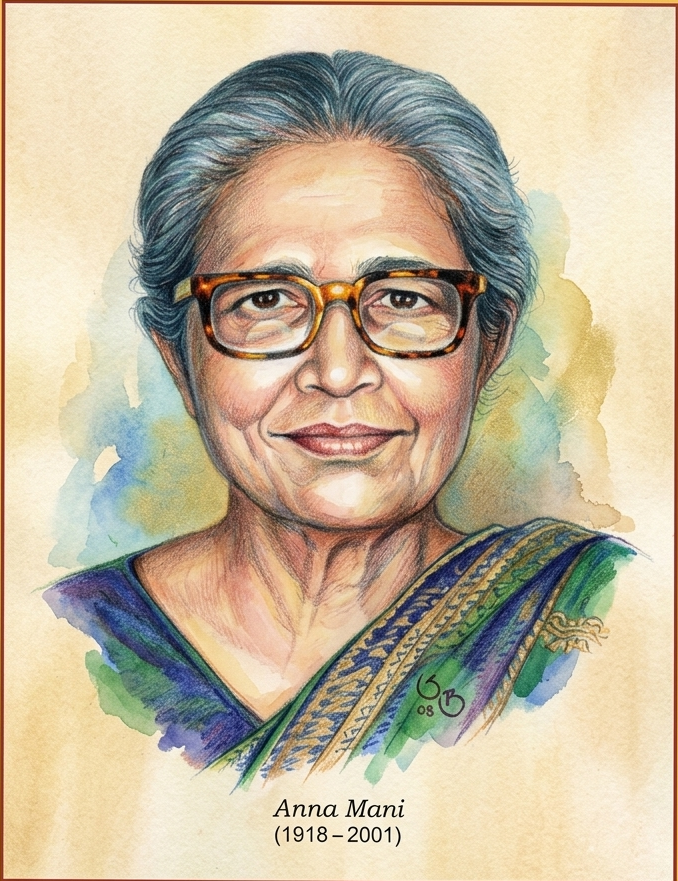
When we check the weather forecast on our phones today, we rarely think about the intricate instruments that measure temperature, humidity, wind speed, and solar radiation. In India, the foundation of this vast observational network was built largely by one remarkable woman — Anna Mani, a brilliant physicist turned meteorologist who designed and manufactured over 200 weather instruments and is rightfully called the "Weather Woman of India."
Her story is one of scientific curiosity, relentless determination, and groundbreaking contributions that transformed India’s meteorological capabilities from a colonial-era setup into a modern, self-reliant observational network. This study guide explores her life, work, and enduring legacy.
1. Early Life and Education: The Making of a Scientist
Anna Mani was born on August 23, 1918, in Peermade, a small hill station in the princely state of Travancore (present-day Kerala). She was the youngest of eight children in a Syrian Christian family. Her father, Issac Mani, was a journalist and social reformer, and her mother, Mariamma Mani, was a homemaker who valued education deeply.
Key Educational Milestones:
- Schooling: She completed her early education in Trivandrum (now Thiruvananthapuram) and showed exceptional academic brilliance from a young age.
- Bachelor’s Degree: She graduated in Physics from Maharaja’s College, Trivandrum (now University College), topping the university.
- Master’s Degree: She earned her M.Sc. in Physics from the same institution with distinction.
- Research at IISc: In 1942, she joined the prestigious Indian Institute of Science (IISc), Bangalore, to pursue research under the legendary Nobel laureate Sir C.V. Raman.
Research Under C.V. Raman:
At IISc, Anna Mani worked on the optical properties of minerals and the photochemical effects of light. Her work was published in the Indian Journal of Physics, and she quickly gained recognition as a meticulous and innovative researcher. It was here that she developed the experimental skills and precision that would later define her meteorological work.
2. The Transition to Meteorology: A Nation’s Need
In 1944, India’s meteorological services were still in their infancy. The Indian Meteorological Department (IMD), established in 1875, relied heavily on imported instruments from Britain, which were expensive, difficult to maintain, and often unsuitable for India’s diverse tropical climate.
Recognizing this gap, Dr. G. B. Kulkarni, then Director General of IMD, invited Anna Mani to join the department. Despite having a flourishing career in pure physics, she accepted the challenge — driven by a sense of national duty and scientific curiosity.
She joined the Meteorological Office in Pune and began what would become a 35-year-long journey of revolutionizing India’s weather observation infrastructure.
3. The Instrument Maker: Designing India’s Weather Network
Anna Mani’s most significant contribution was her work in instrumentation. She understood that accurate weather forecasting and climate research depended entirely on the quality and reliability of measuring instruments.
3.1 Designing and Manufacturing Weather Instruments
- Anna Mani personally designed, tested, and oversaw the manufacture of over 200 different types of meteorological instruments.
- These included:
- Thermometers (maximum, minimum, soil temperature)
- Barometers (for atmospheric pressure)
- Hygrometers (for humidity measurement)
- Rain gauges (for precipitation)
- Anemometers (for wind speed)
- Wind vanes (for wind direction)
- Sunshine recorders (for solar radiation)
- Pyranometers (for measuring global solar radiation)
- Ozone monitors (for atmospheric ozone measurement)
3.2 Indigenous Production
- Before Anna Mani’s efforts, India imported almost all meteorological instruments from the UK, Germany, and the USA.
- She collaborated with Indian manufacturers and engineers to indigenize the production of these instruments, drastically reducing costs and ensuring a steady supply across the country.
- Her work made India self-reliant in meteorological instrumentation — a remarkable achievement in the post-independence era.
3.3 Standardization and Calibration
- Anna Mani established rigorous calibration protocols to ensure that instruments across India’s vast and diverse geography gave consistent, comparable readings.
- She set up calibration laboratories and trained technicians in the proper use and maintenance of weather instruments.
4. Solar Radiation and Ozone Research: A Pioneer’s Contribution
Beyond instrumentation, Anna Mani made pioneering contributions to the study of solar radiation and atmospheric ozone in India.
4.1 Solar Radiation Network
- She established a nationwide network of solar radiation observatories across India.
- This network provided critical data on the amount of solar energy reaching different parts of the country — information essential for:
- Agriculture (crop planning and yield prediction)
- Renewable energy (solar power potential assessment)
- Building design (architectural planning for natural lighting and heating)
- Climate research (understanding India’s energy balance)
4.2 Ozone Measurements
- Anna Mani was one of the first scientists in India to systematically measure atmospheric ozone levels.
- She set up ozone monitoring stations and studied the vertical distribution of ozone in the Indian atmosphere.
- Her work laid the foundation for India’s later participation in global studies on the ozone layer and the discovery of the ozone hole over Antarctica.
4.3 Publications
- She authored numerous research papers and a comprehensive book titled "Solar Radiation over India" (published in 1981), which remains a classic reference for scientists studying India’s solar climate.
5. Leadership and Mentorship
Anna Mani was not just a scientist; she was a leader and a mentor who inspired generations of meteorologists and physicists.
- Head of Instruments Division: She rose to become the Head of the Instruments Division at IMD, a position she held with distinction.
- Deputy Director General: She eventually became the Deputy Director General of IMD, one of the highest positions in the organization.
- Training Programs: She designed and conducted training programs for meteorological observers across India, emphasizing the importance of accurate data collection.
- Mentorship: She mentored numerous young scientists, particularly women, encouraging them to pursue careers in physics and meteorology.
6. Awards and Recognition
Anna Mani’s extraordinary contributions were recognized with several prestigious awards:
- Padma Bhushan (1987): India’s third-highest civilian award, for her distinguished service to science.
- INSA (Indian National Science Academy) Medals: She received multiple medals from INSA for her outstanding scientific contributions.
- K. R. Ramanathan Medal: For her work in atmospheric sciences.
- International Recognition: She represented India at numerous international meteorological conferences and was respected globally for her expertise in instrumentation.
7. Personal Life and Legacy
Anna Mani never married. She dedicated her entire life to science and service. Colleagues described her as a woman of immense discipline, sharp intellect, and quiet determination. She was known for her meticulous attention to detail and her ability to solve complex engineering problems with elegant, simple solutions.
Key Facts About Her Life:
- Longevity: She lived to be 102 years old, passing away on August 16, 2020, just a week before her 102nd birthday.
- Lifestyle: She led a simple, austere life, even in her later years, and remained intellectually active well into her 90s.
- Philosophy: She believed that science should serve society and that women had an equal place in every field of scientific endeavor.
8. Why Anna Mani Matters Today
Anna Mani’s work is more relevant than ever in the 21st century, as India faces the challenges of climate change, extreme weather events, and the need for renewable energy.
- Climate Change Research: The solar radiation and ozone data she collected decades ago is now being used by scientists to study long-term climate trends in India.
- Solar Energy Boom: India’s ambitious push for solar power (targeting 500 GW of renewable energy by 2030) relies heavily on the solar radiation data networks she established.
- Weather Forecasting: The IMD’s ability to provide accurate weather warnings — which saves thousands of lives during cyclones and heatwaves — is built on the observational infrastructure she helped create.
- Women in STEM: Anna Mani remains a powerful role model for young girls and women aspiring to careers in science, technology, engineering, and mathematics (STEM).
📝 Quick Revision Checklist (For Exams & VVM)
- Full Name: Anna Mani
- Born: August 23, 1918, Peermade, Travancore (Kerala)
- Died: August 16, 2020 (aged 101)
- Education: M.Sc. in Physics from Maharaja’s College, Trivandrum
- Research Mentor: Sir C.V. Raman at IISc Bangalore
- Joined IMD: 1944
- Key Contribution: Designed and manufactured 200+ meteorological instruments
- Indigenization: Made India self-reliant in weather instrument production
- Research Areas: Solar radiation, atmospheric ozone, instrumentation
- Major Book: "Solar Radiation over India" (1981)
- Top Position: Deputy Director General of IMD
- Major Award: Padma Bhushan (1987)
- Nickname: "Weather Woman of India"
- Legacy: Established India’s solar radiation observatory network; mentor to women in science
💡 Did You Know? (Bonus Facts for Exams)
- From Physics to Weather: Anna Mani started her career as a pure physicist working on the optical properties of minerals under C.V. Raman. Her transition to meteorology shows how scientific skills are transferable across disciplines.
- 200+ Instruments: She didn’t just use weather instruments — she designed and built over 200 different types, many of which are still in use today in some form.
- 102 Years of Life: She lived for over a century, witnessing India’s transformation from a British colony to a space-faring, nuclear-powered nation. She saw the first weather satellites launched and lived to see India land on the Moon.
- Solar Energy Pioneer: Her solar radiation data from the 1950s-1970s is still being used today to plan solar power projects in India — a testament to the quality and longevity of her work.
- Self-Reliance Champion: At a time when India depended on foreign technology for almost everything, she proved that Indian scientists could design and manufacture world-class instruments at a fraction of the cost.
A Final Thought for Young Scientists
Anna Mani’s life teaches us several invaluable lessons:
- Science is Service: She didn’t pursue science for fame or fortune; she pursued it to solve real problems for her country.
- Precision Matters: Her meticulous attention to calibration and standardization reminds us that in science, the quality of your data is only as good as the quality of your instruments.
- Break Barriers: As a woman in a male-dominated field in the 1940s and 1950s, she faced countless obstacles but never let them define her limits.
- Lifelong Learning: She remained intellectually curious and active well into her 100s, proving that the pursuit of knowledge has no age limit.
When you check the weather on your phone tomorrow, remember Anna Mani. Remember that behind every data point, every forecast, and every weather warning, there are decades of dedicated work by scientists like her who believed that understanding the sky was essential to protecting the people on the ground.
Let her legacy inspire you to look up at the sky with curiosity, and to pursue science with the same dedication, precision, and patriotism that defined her extraordinary life.
If you found this study guide helpful, bookmark it for your exam revisions! Let us know in the comments which aspect of Anna Mani’s life inspires you the most.
Jai Vigyan! Jai Vidya!
Keywords : anna her india indian instruments life mani meteorological network over ozone physics radiation research science she solar that weather work
🔔 हमारे YouTube चैनल को सब्सक्राइब करें:
👉 https://www.youtube.com/channel/UC76hj0iZcKkiW1YizHs0n2Q/
📘 Facebook Page:
👉 https://www.facebook.com/DigiTatvaPlus
🌿 वेबसाइट विजिट करें:
👉 https://www.bhaktipulse.com/
👉 https://www.bhaktipulse.com/video
✨ Guest Post Invitation – Share Your Divine Wisdom
🙏 Welcome to BhaktiPulse – your spiritual companion for Aarti, Chalisa, Bhajan, Mantra, and divine stories.
🌸 Do you have spiritual knowledge, devotional content, experiences, or stories that can inspire others?
📖 We warmly invite you to contribute your valuable content and become a part of our growing spiritual community.
✨ Your content may include:
- 🪔 Aarti, Chalisa, Mantra, Bhajan
- 📜 Spiritual stories & life lessons
- 🔍 Unknown facts & scientific reasons in Sanatan Dharma
- 🌿 Ayurveda, rituals, and traditions
💡 If your content aligns with our vision, we will proudly feature it on BhaktiPulse.
📩 Submit your content or contact us here:
👉 https://www.bhaktipulse.com/contact.php
🌼 Let your words spread devotion, ज्ञान, and positivity to the world.
🙏 Join us in this divine journey!
💬 Comments
Approved Comments