The Ancient Sages of Science: A Comprehensive Study Guide to Ancient Indian Scientists
73 Visited Vidyarthi Vigyan Manthan (VVM) • Updated: Saturday, 18 July 2026
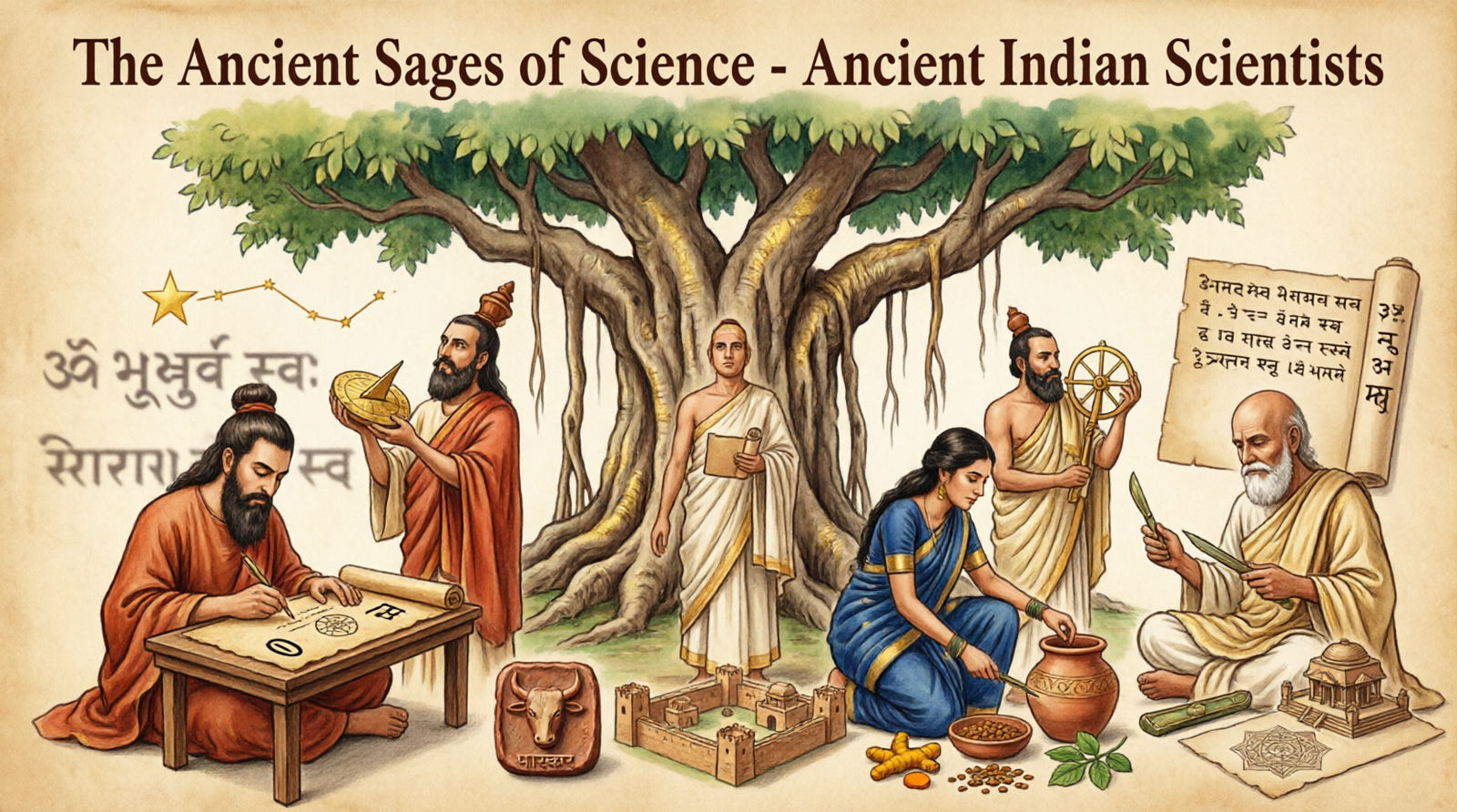
Long before the term "scientist" was coined in the 19th century, ancient India was home to brilliant minds who systematically observed, experimented, and documented the natural world. These scholar-sages, often called Rishis or Acharyas, made groundbreaking contributions to mathematics, astronomy, medicine, physics, chemistry, and engineering that would later influence civilizations across the globe.
This comprehensive study guide explores the lives, works, and enduring legacies of ancient India's greatest scientific minds—individuals who laid the foundations of modern science while working with nothing but keen observation, logical reasoning, and remarkable intellectual rigor.
Part 1: The Vedic Pioneers — Science in the Age of Mantras
The earliest scientific thought in India is embedded in the Vedas (c. 1500–500 BCE), ancient texts that contain not just spiritual wisdom but also sophisticated observations about mathematics, astronomy, medicine, and the natural world.
1. The Vedic Rishis (c. 1500–1000 BCE)
- Field: Multi-disciplinary (Mathematics, Astronomy, Linguistics, Medicine)
- Key Contributions:
- Mathematics: The Shulba Sutras (appendices to the Vedas) contain early geometric principles, including the Pythagorean theorem (centuries before Pythagoras), methods for constructing altars with precise measurements, and approximations of √2.
- Astronomy: The Vedanga Jyotisha (c. 1400 BCE) is one of the earliest known texts on astronomy, describing lunar and solar movements, calendrical calculations, and the division of the year into seasons.
- Linguistics: Panini's Ashtadhyayi (c. 4th century BCE, building on Vedic traditions) created a formal grammar system for Sanskrit that is considered one of the earliest examples of formal language theory—predating modern computer science by millennia.
- Medicine: The Atharvaveda contains references to medicinal plants, anatomical knowledge, and early concepts of disease causation.
- Legacy: The Vedic rishis established a tradition of systematic observation, classification, and documentation that became the hallmark of Indian scientific inquiry.
Part 2: The Masters of Mathematics — Architects of Numbers
Ancient Indian mathematicians revolutionized the world of numbers, giving humanity concepts like zero, the decimal system, and advanced algebraic and trigonometric principles.
2. Baudhayana (c. 800–600 BCE)
- Title: The Geometrician of the Shulba Sutras
- Key Work: Baudhayana Shulba Sutra (part of the Krishna Yajurveda)
- Key Contributions:
- Pythagorean Theorem: Stated the theorem centuries before Pythagoras: "The rope which is stretched across the diagonal of a square produces an area double the size of the original square" and "The diagonal of a rectangle produces both (areas) which its length and breadth produce separately."
- Value of √2: Provided a remarkably accurate approximation of √2 as 1.4142156 (correct to five decimal places).
- Circle Squaring: Attempted the problem of "squaring the circle" (constructing a square with the same area as a given circle).
- Geometric Constructions: Provided methods for constructing altars of various shapes (squares, rectangles, circles, semicircles) with precise areas.
- Legacy: His work represents some of the earliest known geometry in human history and demonstrates that Indian mathematicians understood complex geometric relationships millennia before the Greeks.
3. Apastamba (c. 600–500 BCE)
- Field: Geometry and Mathematics
- Key Work: Apastamba Shulba Sutra
- Key Contributions:
- Refined geometric constructions for Vedic rituals.
- Provided methods for transforming one geometric shape into another while preserving area.
- Contributed to early understanding of irrational numbers.
4. Katyayana (c. 300–200 BCE)
- Field: Geometry
- Key Work: Katyayana Shulba Sutra
- Key Contributions:
- Provided the general form of the Pythagorean theorem for rectangles.
- Gave methods for constructing squares and rectangles with specific area relationships.
- Contributed to the understanding of geometric transformations.
5. Pingala (c. 300–200 BCE)
- Title: The Pioneer of Binary Numbers
- Key Work: Chandahshastra (The Art of Prosody)
- Key Contributions:
- Binary Number System: Developed a binary numeral system (using only 0 and 1, though represented differently) to classify poetic meters—over 1,800 years before Leibniz formalized binary in Europe.
- Pascal's Triangle: Described what is now known as Pascal's Triangle (called Meru Prastara in Sanskrit) for calculating combinations in prosody.
- Fibonacci Numbers: His work on poetic meters implicitly contained the Fibonacci sequence.
- Combinatorics: Developed methods for calculating combinations and permutations of syllables in Sanskrit poetry.
- Legacy: His work on binary systems and combinatorics is now recognized as foundational to computer science and information theory.
6. Aryabhata (476–550 CE)
- Title: The Father of Indian Mathematics and Astronomy
- Key Work: Aryabhatiya (written in 499 CE at age 23)
- Key Contributions:Mathematics:
- Place-Value System: Explicitly used a place-value system, though he did not use a symbol for zero.
- Approximation of π (Pi): Calculated π as 3.1416, accurate to four decimal places. He stated: "Add four to 100, multiply by eight, and then add 62,000. By these rules, the circumference of a circle with a diameter of 20,000 can be approximated." This gives: (100+4) × 8 + 62,000 = 62,832; 62,832/20,000 = 3.1416.
- Trigonometry: Introduced the concept of sine (jya), cosine (kojya), and versine (utkrama-jya). Created the first sine table with values at intervals of 3.75°.
- Algebra: Solved indeterminate equations (equations with multiple variables) using the Kuttaka (pulverizer) method.
- Summation Formulas: Provided formulas for the sum of squares and cubes of the first n natural numbers:
- Sum of squares: n(n+1)(2n+1)/6
- Sum of cubes: [n(n+1)/2]²
Astronomy:
- Earth's Rotation: Proposed that the Earth rotates on its own axis, explaining the apparent movement of stars.
- Heliocentric Elements: Suggested that planets shine by reflected sunlight and that the Moon and planets reflect sunlight.
- Eclipses: Correctly explained that solar and lunar eclipses occur due to the shadows of the Earth and Moon, not due to mythological demons (Rahu and Ketu).
- Planetary Positions: Calculated planetary positions and the length of the year as 365.25868 days (very close to the modern value of 365.25636 days).
- Diameter of Earth: Calculated Earth's circumference as 24,835 miles (remarkably close to the modern equatorial circumference of 24,901 miles).
- Major Works: Aryabhatiya (499 CE), Aryabhata Siddhanta (now lost)
- Legacy: Aryabhata was the first major mathematician-astronomer of the classical age of Indian mathematics. His work influenced Islamic astronomy and, through it, European science. India's first satellite was named Aryabhata in his honor.
7. Brahmagupta (598–668 CE)
- Title: The Rule-Maker of Zero and Negative Numbers
- Key Work: Brahmasphutasiddhanta (628 CE), Khandakhadyaka (665 CE)
- Key Contributions:Mathematics:
- Zero as a Number: First to treat zero as a number in its own right (not just a placeholder) and provide rules for arithmetic operations involving zero.
- Rules for Zero:
- a + 0 = a
- a − 0 = a
- 0 × a = 0
- 0/0 = 0 (incorrect, but an early attempt)
- Negative Numbers: Introduced negative numbers (called "debts") and positive numbers (called "fortunes") and established rules for their arithmetic:
- Debt − 0 = Debt
- Fortune − 0 = Fortune
- 0 − 0 = 0
- Debt × Debt = Fortune (negative × negative = positive)
- Fortune × Fortune = Fortune (positive × positive = positive)
- Debt × Fortune = Debt (negative × positive = negative)
- Quadratic Equations: Provided the first clear solution to the general quadratic equation: ax² + bx + c = 0
- Brahmagupta's Formula: Discovered a formula for the area of a cyclic quadrilateral (a four-sided figure inscribed in a circle):
- Area = √[(s−a)(s−b)(s−c)(s−d)] where s is the semi-perimeter and a, b, c, d are the sides.
- Brahmagupta's Theorem: In a cyclic quadrilateral with perpendicular diagonals, the perpendicular from the intersection of the diagonals to any side bisects the opposite side.
- Pell's Equation: Made significant progress on solving indeterminate equations of the form x² − Ny² = 1.
Astronomy:
- Calculated the length of the solar year as 365.258756 days.
- Provided methods for calculating eclipses and planetary positions.
- Criticized the Puranic view that the Earth was flat or hollow.
- Legacy: Brahmagupta's formalization of zero and negative numbers revolutionized mathematics. His work was translated into Arabic and influenced Islamic mathematics, which later transmitted these concepts to Europe.
8. Bhaskara I (c. 600–680 CE)
- Field: Mathematics and Astronomy
- Key Works: Mahabhaskariya, Laghubhaskariya, Aryabhatiyabhashya (commentary on Aryabhata)
- Key Contributions:
- Sine Approximation: Provided a remarkable rational approximation for the sine function:
- sin x° ≈ 4x(180−x) / [40,500 − x(180−x)] This formula is accurate to within 2% for values between 0° and 180°.
- Commentary on Aryabhata: Wrote the oldest known commentary on Aryabhata's Aryabhatiya, preserving and explaining earlier mathematical knowledge.
- Astronomical Calculations: Improved methods for calculating planetary positions and eclipses.
- Sine Approximation: Provided a remarkable rational approximation for the sine function:
9. Mahavira (c. 800–870 CE)
- Title: The Systematizer of Indian Mathematics
- Key Work: Ganita Sara Sangraha (850 CE)
- Key Contributions:
- First Separate Mathematical Text: Wrote the first Indian text devoted entirely to mathematics (separating it from astronomy).
- Algebra: Systematized algebraic terminology and operations.
- Zero: Corrected Brahmagupta's error, stating that a number divided by zero remains unchanged (an early conceptualization of infinity).
- Fractions: Developed methods for expressing fractions as sums of unit fractions.
- Combinatorics: Provided formulas for calculating permutations and combinations.
- Geometry: Gave formulas for the area and perimeter of ellipses.
- Legacy: His work was influential in South India and was translated into several regional languages, spreading mathematical knowledge across the subcontinent.
10. Bhaskaracharya II (1114–1185 CE)
- Title: The Master of Calculus Precursors
- Key Work: Siddhanta Shiromani (1150 CE), divided into four parts:
- Lilavati (Arithmetic and Geometry)
- Bijaganita (Algebra)
- Grahaganita (Mathematics of the Planets)
- Goladhyaya (Sphere and Astronomy)
- Key Contributions:Mathematics:
- Preliminary Calculus: Developed concepts that would later become differential calculus:
- Discussed the concept of tatkalika (instantaneous motion).
- Recognized that at the highest or lowest point of a planet's orbit, its instantaneous rate of change is zero (equivalent to finding where the derivative equals zero).
- This work predated Newton and Leibniz by over 500 years.
- Division by Zero: Correctly deduced that dividing a finite number by an infinitesimally small number results in infinity (Ananta). He stated: "Just as the infinite, unchanging Vishnu pervades the universe, so does infinity remain unchanged when numbers are added to or subtracted from it."
- Pell's Equation: Developed the Chakravala (cyclic) method to solve indeterminate quadratic equations of the form x² − Ny² = 1. This method is remarkably efficient and was unknown in Europe until the 17th century.
- Algebra: Solved cubic and quartic equations. Provided solutions for equations with multiple unknowns.
- Trigonometry: Developed spherical trigonometry and created more accurate sine tables.
- Calculus Concepts: Understood that the differential coefficient (derivative) vanishes at an extremum (maximum or minimum).
Astronomy:
- Calculated the length of the tropical year as 365.2585 days (very close to the modern value).
- Accurately calculated planetary positions and motions.
- Proposed that the Earth has a gravitational force (Gurutvakarshan) that attracts objects.
Lilavati:
- Named after his daughter (according to legend), this mathematical text is written in poetic verse and covers arithmetic, geometry, and algebra in an accessible, engaging manner.
- Contains problems on interest, profit and loss, mixtures, and progressions.
- Preliminary Calculus: Developed concepts that would later become differential calculus:
- Legacy: Bhaskaracharya II represents the pinnacle of classical Indian mathematics. His work on calculus precursors, Pell's equation, and algebra influenced both Islamic and later European mathematics.
11. Madhava of Sangamagrama (c. 1340–1425 CE)
- Title: The Founder of the Kerala School of Mathematics
- Key Contributions:
- Infinite Series: Discovered infinite series expansions for trigonometric functions over 200 years before European mathematicians:
- Madhava-Leibniz Series for π: π/4 = 1 − 1/3 + 1/5 − 1/7 + 1/9 − ...
- Sine Series: sin x = x − x³/3! + x⁵/5! − x⁷/7! + ...
- Cosine Series: cos x = 1 − x²/2! + x⁴/4! − x⁶/6! + ...
- Arctangent Series: arctan x = x − x³/3 + x⁵/5 − x⁷/7 + ...
- Value of π: Calculated π to 11 decimal places (3.14159265359) using his infinite series—remarkably accurate for the 14th century.
- Taylor Series: Developed Taylor series approximations for trigonometric functions centuries before Brook Taylor.
- Calculus: Developed concepts of integration and differentiation, including term-by-term integration and approximation methods.
- Infinite Series: Discovered infinite series expansions for trigonometric functions over 200 years before European mathematicians:
- Legacy: Madhava and the Kerala School made discoveries that would not be rediscovered in Europe for another 200–300 years. Some historians argue that knowledge of these discoveries may have been transmitted to Europe through Jesuit missionaries, potentially influencing the development of calculus by Newton and Leibniz.
Part 3: The Healers — Masters of Ancient Medicine
Ancient Indian physicians developed sophisticated systems of medicine that emphasized prevention, holistic treatment, and surgical innovation.
12. Dhanvantari (Mythological/Legendary, c. Vedic Period)
- Title: The Divine Physician
- Key Contribution: Regarded as the god of Ayurveda and the physician of the gods (Devas). He is said to have emerged during the churning of the ocean (Samudra Manthan) carrying the pot of nectar (Amrita).
- Legacy: Considered the patron deity of Ayurveda. His birthday is celebrated as Dhanteras in India.
13. Charaka (c. 300 BCE – 200 CE)
- Title: The Father of Ayurvedic Medicine
- Key Work: Charaka Samhita (revised and expanded from the earlier Agnivesha Samhita)
- Key Contributions:Medicine:
- Comprehensive Medical Text: The Charaka Samhita is one of the foundational texts of Ayurveda, covering internal medicine (Kayachikitsa).
- Digestion and Metabolism: Described the concept of Agni (digestive fire) and its role in metabolism and health.
- Immunology: Understood concepts of immunity and disease resistance.
- Genetics: Discussed the role of parents in determining the characteristics of offspring, including genetic diseases.
- Pharmacology: Described hundreds of medicinal plants and their properties.
- Preventive Medicine: Emphasized prevention through proper diet, lifestyle, and seasonal routines (Dinacharya and Ritucharya).
- Medical Ethics: Outlined ethical guidelines for physicians, including patient confidentiality and the duty to treat all patients regardless of status.
- Anatomy: Described the human body as having 360 bones (including teeth and cartilage—close to the modern count of 206 bones, depending on how they're counted).
- Circulation: Understood that the heart is the center of circulation, though the full mechanism was not understood.
Philosophy of Medicine:
- Proposed that health is a balance of three Doshas (humors): Vata (air/space), Pitta (fire/water), and Kapha (earth/water).
- Disease results from an imbalance of these doshas.
- Legacy: The Charaka Samhita remains a foundational text of Ayurveda and is still studied today. Charaka's emphasis on holistic, preventive medicine resonates with modern integrative health approaches.
14. Sushruta (c. 600 BCE)
- Title: The Father of Surgery
- Key Work: Sushruta Samhita
- Key Contributions:Surgery:
- Comprehensive Surgical Text: The Sushruta Samhita is the oldest known text dedicated to surgery, describing over 300 surgical procedures and 120+ surgical instruments.
- Plastic Surgery (Rhinoplasty): Described the first known rhinoplasty (nose reconstruction) procedure in detail:
- Used a flap of skin from the forehead or cheek to reconstruct the nose.
- This technique, known as the "Indian method," was later adopted in Europe in the 18th century.
- Cataract Surgery: Described couching—a procedure to remove cataracts using a curved needle to push the cloudy lens aside.
- Cesarean Section: Described procedures for delivering babies when natural birth was not possible.
- Lithotomy: Described the removal of bladder stones.
- Wound Management: Detailed techniques for wound cleaning, suturing, and dressing.
- Fracture Treatment: Described methods for setting broken bones and using splints.
Surgical Instruments:
- Designed and described over 120 surgical instruments, including:
- Scalpels (Shastra)
- Forceps (Sandamsa)
- Probes (Salaka)
- Scissors (Kutharika)
- Catheters (Nadi)
- Trocars (Vedhaka)
Anatomy:
- Advocated for the study of anatomy through dissection of dead bodies (a radical idea for the time).
- Described the human body as having:
- 300 bones
- 900 ligaments
- 700 veins
- 500 muscles
- 360 bones (depending on the counting method)
- Correctly described the heart as having four chambers.
Medical Training:
- Emphasized practical training: Students were to practice surgical techniques on vegetables, dead animals, and models before operating on living patients.
- Stressed the importance of observation, experience, and continuous learning.
- Legacy: Sushruta's surgical techniques, especially rhinoplasty, influenced surgical practices worldwide. His emphasis on practical training and anatomical study was centuries ahead of its time. The Sushruta Samhita remains a cornerstone of Ayurvedic surgical education.
15. Vagbhata (c. 6th–7th Century CE)
- Title: The Synthesizer of Ayurveda
- Key Work: Ashtanga Hridaya and Ashtanga Sangraha
- Key Contributions:
- Synthesis: Combined the knowledge of Charaka (internal medicine) and Sushruta (surgery) into comprehensive, systematic texts.
- Organization: Organized Ayurvedic knowledge into eight branches (Ashtanga):
- Kayachikitsa (Internal Medicine)
- Shalya Tantra (Surgery)
- Shalakya Tantra (Diseases of Eyes, Ears, Nose, Throat)
- Kaumarabhritya (Pediatrics)
- Agada Tantra (Toxicology)
- Bhuta Vidya (Psychiatry)
- Rasayana (Rejuvenation)
- Vajikarana (Aphrodisiac Therapy)
- Accessibility: Wrote in clear, concise Sanskrit verse, making Ayurvedic knowledge more accessible to students.
- Pharmacology: Described formulations, dosages, and therapeutic applications of numerous medicinal compounds.
- Legacy: Vagbhata's works became standard textbooks of Ayurveda and are still studied today. His systematic organization of Ayurvedic knowledge helped preserve and transmit this medical tradition.
16. Kashyapa (c. 6th Century BCE)
- Title: The Pioneer of Pediatrics
- Key Work: Kashyapa Samhita
- Key Contributions:
- Pediatrics: Specialized in the health and diseases of children (Kaumarabhritya).
- Neonatal Care: Described care for newborns, including umbilical cord care and breastfeeding.
- Child Development: Discussed developmental milestones and childhood diseases.
- Obstetrics: Provided guidance on pregnancy, childbirth, and postpartum care.
- Women's Health: Addressed gynecological conditions and treatments.
- Legacy: Kashyapa is considered the father of Indian pediatrics. His work laid the foundation for specialized care of children in Ayurvedic medicine.
Part 4: The Astronomers — Mappers of the Cosmos
Ancient Indian astronomers made remarkably accurate observations of celestial bodies and developed sophisticated mathematical models to predict planetary motions, eclipses, and time.
17. Varahamihira (505–587 CE)
- Title: The Master of Astronomy and Astrology
- Key Works:
- Pancha Siddhantika (The Five Astronomical Canons)
- Brihat Samhita (The Great Compilation)
- Brihat Jataka (On Astrology)
- Key Contributions:Astronomy:
- Synthesis of Knowledge: The Pancha Siddhantika summarizes five earlier astronomical traditions:
- Surya Siddhanta
- Romaka Siddhanta (showing Greek/Roman influence)
- Paulisa Siddhanta
- Vasishtha Siddhanta
- Paitamaha Siddhanta
- Preservation: His work preserved astronomical knowledge from earlier texts that are now lost.
- Planetary Motions: Provided methods for calculating planetary positions and motions.
- Eclipses: Described methods for predicting solar and lunar eclipses.
Brihat Samhita:
- Encyclopedic Work: A comprehensive encyclopedia covering astronomy, mathematics, geography, meteorology, and more.
- Meteorology: Described cloud formation, rainfall prediction, and weather patterns.
- Hydrology: Provided methods for detecting underground water using indicator plants and termite mounds.
- Architecture: Discussed principles of construction and town planning.
- Gemology: Described the properties and testing of precious stones.
Mathematics:
- Contributed to trigonometry and algebra.
- Improved sine tables and astronomical calculations.
- Synthesis of Knowledge: The Pancha Siddhantika summarizes five earlier astronomical traditions:
- Legacy: Varahamihira was one of the "Nine Jewels" (Navaratnas) in the court of King Yashodharman Vikramaditya. His encyclopedic works preserved and synthesized vast amounts of ancient Indian knowledge.
18. Lalla (c. 720–790 CE)
- Field: Astronomy and Mathematics
- Key Work: Sishyadhivrddhida (Treatise which Removes the Ignorance of Pupils)
- Key Contributions:
- Critiqued and corrected earlier astronomical models.
- Improved methods for calculating planetary positions.
- Discussed the Earth's rotation and the causes of day and night.
- Provided accurate calculations for eclipses.
19. Shripati (c. 1019–1066 CE)
- Field: Astronomy and Astrology
- Key Works: Siddhanta Shekhara, Jyotish Ratna Mala
- Key Contributions:
- Refined astronomical calculations and planetary models.
- Contributed to algebra and arithmetic.
- Wrote extensively on astrology and timekeeping.
20. Nilakantha Somayaji (1444–1544 CE)
- Title: The Astronomer of the Kerala School
- Key Work: Tantra Sangraha (1501 CE)
- Key Contributions:
- Planetary Model: Proposed a computational system for astronomy that was mathematically more efficient than the earlier models.
- Heliocentric Elements: Suggested that Mercury, Venus, Mars, Jupiter, and Saturn orbit the Sun, which in turn orbits the Earth—a system mathematically similar to the Tychonic system proposed in Europe later.
- Infinite Series: Contributed to the development of infinite series for trigonometric functions (building on Madhava's work).
- Eclipse Calculations: Provided more accurate methods for predicting eclipses.
- Legacy: Nilakantha represents the sophisticated astronomical tradition of the Kerala School, which made advances centuries before similar developments in Europe.
Part 5: The Engineers and Architects — Builders of Civilization
Ancient Indian engineers and architects created structures and systems that demonstrated advanced understanding of materials, mechanics, and urban planning.
21. Vishwakarma (Mythological/Legendary)
- Title: The Divine Architect
- Key Contribution: Regarded as the architect of the gods and the divine craftsman in Hindu mythology. He is credited with designing and building:
- The city of Dwarka (Krishna's capital)
- Indraprastha (the Pandavas' capital)
- Various divine weapons and vehicles
- Legacy: Vishwakarma is considered the patron deity of engineers, architects, and craftsmen. Vishwakarma Puja is celebrated by engineers and artisans in India.
22. The Indus Valley Engineers (c. 3300–1300 BCE)
- Field: Urban Planning and Civil Engineering
- Key Contributions:Urban Planning:
- Grid System: Designed cities like Mohenjo-daro and Harappa with precise grid layouts, with streets running north-south and east-west.
- Standardization: Used standardized brick sizes (ratio of 4:2:1) across cities hundreds of miles apart.
- Zoning: Separated residential areas from public buildings and industrial zones.
Water Management:
- Advanced Drainage: Created covered drainage systems with manholes for cleaning—a feature not seen again until Roman times.
- Water Supply: Built wells in nearly every house and public bathing areas.
- Great Bath: Constructed the Great Bath of Mohenjo-daro, a large public water tank with sophisticated waterproofing using bitumen.
- Dockyard: Built the world's earliest known tidal dockyard at Lothal (c. 2400 BCE), with a basin connected to an ancient river course for ship maintenance.
Architecture:
- Granaries: Built massive granaries with raised platforms and ventilated walls for grain storage.
- Multi-story Buildings: Constructed two and three-story houses with bathrooms and toilets.
- Materials: Used fired bricks, which were more durable than sun-dried bricks.
- Legacy: The Indus Valley Civilization demonstrates some of the earliest examples of urban planning, civil engineering, and water management in human history.
23. Maya Asura (Mythological/Legendary)
- Title: The Architect of Demons
- Key Contribution: In Hindu mythology, Maya Asura was the architect of the demons (Asuras) and is credited with creating:
- The three cities of gold, silver, and iron (Tripura)
- Illusory structures and magical architecture
- Legacy: Represents the ancient understanding of architectural illusion and advanced construction techniques.
Part 6: The Physicists and Chemists — Explorers of Matter and Energy
Ancient Indian thinkers developed sophisticated theories about the nature of matter, energy, and the physical universe.
24. Kanada (c. 6th–2nd Century BCE)
- Title: The Father of Atomic Theory
- Key Work: Vaisheshika Sutra
- Key Contributions:Atomic Theory:
- Atomism: Proposed that all matter is composed of indivisible particles called Paramanu (atoms).
- Properties of Atoms:
- Atoms are eternal, indestructible, and the basis of all material existence.
- Atoms are invisible to the naked eye.
- Atoms combine in various ways to produce chemical changes.
- Atoms can exist in states of motion or absolute rest.
- Chemical Reactions: Explained that chemical reactions occur when atoms combine under specific conditions (such as heat).
- Classification: Classified all objects in the universe into nine substances: earth, water, light, wind, ether, time, space, soul, and mind.
Physics:
- Motion: Discussed different types of motion and their causes.
- Gravity: Suggested that objects fall to Earth due to an inherent property (Gurutva), an early concept of gravity.
- Heat and Light: Explained that heat and light are forms of energy that can transform matter.
- Legacy: Kanada's atomic theory predates Democritus (the Greek atomist) by at least a century. His ideas about atoms and chemical reactions represent one of the earliest formulations of atomic theory in human history.
25. Pakudha Kaccayana (c. 6th Century BCE)
- Field: Natural Philosophy and Physics
- Key Contributions:
- Proposed that the universe is composed of seven eternal, unchanging elements: earth, water, fire, air, pleasure, pain, and soul.
- Suggested that these elements do not interact or change, an early form of atomism.
- His ideas influenced later Indian philosophical and scientific thought.
26. Nagarjuna (c. 931–1013 CE)
- Title: The Alchemist and Chemist
- Key Work: Rasaratnakara (The Ocean of Mercury)
- Key Contributions:Chemistry and Alchemy:
- Metallurgy: Described methods for extracting and purifying metals, including gold, silver, copper, iron, tin, and lead.
- Mercury: Studied the properties of mercury and its compounds extensively.
- Distillation: Described distillation processes for purifying substances.
- Chemical Reactions: Documented numerous chemical reactions and the preparation of various compounds.
- Medicinal Chemistry: Developed methods for preparing medicinal compounds using metals and minerals.
Materials Science:
- Described the properties of various materials and their applications.
- Developed techniques for creating alloys and composite materials.
- Legacy: Nagarjuna's work represents the sophisticated chemical knowledge of medieval India. His methods for metal extraction and purification influenced later alchemical and chemical traditions.
Part 7: The Grammarians and Linguists — Scientists of Language
Ancient Indian scholars developed remarkably sophisticated systems for analyzing language, grammar, and phonetics that anticipated modern linguistic and computational theory.
27. Panini (c. 4th Century BCE)
- Title: The Father of Linguistics
- Key Work: Ashtadhyayi (Eight Chapters)
- Key Contributions:Grammar:
- Formal Grammar: Created a comprehensive, rule-based grammar for Sanskrit consisting of nearly 4,000 sutras (rules).
- Generative Grammar: His system is generative—starting from a small set of rules and a lexicon, it can generate all grammatically correct Sanskrit sentences.
- Morphology: Described the formation of words from roots and affixes with remarkable precision.
- Phonetics: Developed a sophisticated phonetic system, classifying sounds by place and manner of articulation.
Mathematical Structure:
- Algorithmic Approach: His grammar operates like an algorithm, with rules applied in a specific order to transform inputs into outputs.
- Meta-Rules: Included meta-rules that govern the application of other rules.
- Recursion: Used recursive rules, a concept fundamental to modern computer science and formal language theory.
Linguistic Science:
- Distinguished between the spoken language (Bhasha) and the sacred language (Chhandas).
- Described the evolution of language and dialects.
- Legacy: Panini's Ashtadhyayi is considered one of the greatest intellectual achievements in human history. His formal, rule-based approach to grammar anticipated modern formal language theory, computational linguistics, and computer programming by over 2,000 years. Linguists and computer scientists still study his work today.
28. Patanjali (c. 2nd Century BCE)
- Title: The Commentator and Philosopher
- Key Works:
- Mahabhashya (Great Commentary on Panini's grammar)
- Yoga Sutras (on yoga philosophy)
- Key Contributions:
- Linguistics: Wrote an extensive commentary on Panini's grammar, clarifying and expanding upon the rules.
- Philosophy of Language: Discussed the relationship between words and meaning, contributing to the philosophy of language.
- Yoga Science: Systematized the practice of yoga into an eight-limbed path (Ashtanga Yoga), contributing to the science of mind-body health.
Part 8: The Polymaths — Masters of Multiple Disciplines
Some ancient Indian scientists excelled in multiple fields, making contributions across mathematics, astronomy, medicine, and philosophy.
29. Acharya Kapila (c. 6th Century BCE)
- Title: The Founder of Samkhya Philosophy
- Key Contributions:
- Philosophy: Founded the Samkhya school of Hindu philosophy, one of the six orthodox schools.
- Cosmology: Developed a dualistic cosmology distinguishing between Purusha (consciousness) and Prakriti (matter).
- Evolution: Described a theory of cosmic evolution from primordial matter to the diversity of the universe.
- Psychology: Analyzed the nature of mind, intellect, and ego.
- Legacy: Kapila's Samkhya philosophy influenced later Indian thought, including yoga and Ayurveda. His systematic analysis of reality anticipated later philosophical and scientific inquiry.
30. Acharya Kanad (Not to be confused with Kanada the atomist)
- Field: Multiple disciplines
- Note: Sometimes conflated with Kanada the atomist, but may refer to different historical figures in various traditions.
📝 Quick Revision Checklist (For Exams & VVM)
|
Scientist |
Period |
Field |
Key Contribution |
Major Work |
|---|---|---|---|---|
|
Vedic Rishis |
1500–500 BCE |
Multi-disciplinary |
Early math, astronomy, linguistics |
Vedas, Shulba Sutras |
|
Baudhayana |
800–600 BCE |
Geometry |
Pythagorean theorem, 2 approximation |
Baudhayana Shulba Sutra |
|
Pingala |
300–200 BCE |
Mathematics |
Binary numbers, Pascal's Triangle |
Chandahshastra |
|
Aryabhata |
476–550 CE |
Math/Astronomy |
π = 3.1416, Earth's rotation, sine table |
Aryabhatiya (499 CE) |
|
Brahmagupta |
598–668 CE |
Mathematics |
Zero rules, negative numbers, quadratic equations |
Brahmasphutasiddhanta (628 CE) |
|
Bhaskara I |
600–680 CE |
Mathematics |
Sine approximation formula |
Mahabhaskariya |
|
Mahavira |
800–870 CE |
Mathematics |
First separate math text, zero/Infinity |
Ganita Sara Sangraha (850 CE) |
|
Bhaskaracharya II |
1114–1185 CE |
Math/Astronomy |
Calculus concepts, Chakravala method |
Siddhanta Shiromani (1150 CE) |
|
Madhava |
1340–1425 CE |
Mathematics |
Infinite series, π to 11 decimals |
(Kerala School) |
|
Charaka |
300 BCE–200 CE |
Medicine |
Internal medicine, immunology, genetics |
Charaka Samhita |
|
Sushruta |
c. 600 BCE |
Surgery |
Rhinoplasty, 300+ procedures, 120+ instruments |
Sushruta Samhita |
|
Vagbhata |
6th–7th CE |
Medicine |
Synthesis of Ayurveda |
Ashtanga Hridaya |
|
Kashyapa |
6th BCE |
Pediatrics |
Child health, obstetrics |
Kashyapa Samhita |
|
Varahamihira |
505–587 CE |
Astronomy |
Five astronomical canons, encyclopedia |
Pancha Siddhantika, Brihat Samhita |
|
Nilakantha |
1444–1544 CE |
Astronomy |
Planetary model, heliocentric elements |
Tantra Sangraha (1501 CE) |
|
Kanada |
6th–2nd BCE |
Physics |
Atomic theory (Paramanu) |
Vaisheshika Sutra |
|
Nagarjuna |
931–1013 CE |
Chemistry |
Metallurgy, distillation, mercury |
Rasaratnakara |
|
Panini |
4th BCE |
Linguistics |
Formal grammar (4,000 rules) |
Ashtadhyayi |
|
Indus Engineers |
3300–1300 BCE |
Civil Engineering |
Urban planning, drainage, dockyard |
Mohenjo-daro, Harappa, Lothal |
💡 Did You Know? (Bonus Facts for Exams)
- Pythagoras Before Pythagoras: Baudhayana stated the Pythagorean theorem in the 8th–6th century BCE, over 300 years before Pythagoras (c. 570–495 BCE).
- Binary Before Bits: Pingala developed a binary numeral system around 300–200 BCE—over 2,000 years before Leibniz formalized binary in Europe (1703 CE).
- Calculus Before Calculus: Bhaskaracharya II developed concepts of differential calculus in the 12th century—over 500 years before Newton and Leibniz.
- Infinite Series Before Europe: Madhava discovered infinite series for trigonometric functions in the 14th century—over 200 years before Gregory, Leibniz, and Taylor.
- Plastic Surgery Before Modern Medicine: Sushruta described rhinoplasty in the 6th century BCE. The "Indian method" of nose reconstruction was later adopted in Europe in the 18th century.
- Zero to Hero: Brahmagupta was the first to treat zero as a number with its own arithmetic rules in 628 CE. This concept revolutionized mathematics worldwide.
- Grammar as Code: Panini's Ashtadhyayi (4th century BCE) is essentially a programming language for Sanskrit, with rules that can generate all grammatically correct sentences. Computer scientists still study it today.
- Atomic Theory Ancient: Kanada proposed atomic theory (Paramanu) in the 6th–2nd century BCE, predating Democritus and Dalton by centuries.
- π Precision: Aryabhata calculated π as 3.1416 in 499 CE—accurate to four decimal places. Madhava later calculated it to 11 decimal places in the 14th century.
- Medical Ethics Ancient: Charaka outlined medical ethics including patient confidentiality and the duty to treat all patients—principles that echo in the modern Hippocratic Oath.
Part 9: The Transmission of Knowledge — How Indian Science Reached the World
Ancient Indian scientific knowledge did not remain confined to the subcontinent. It traveled along trade routes, through translations, and via scholarly exchanges, influencing civilizations across Asia, the Middle East, and eventually Europe.
The Arabic Translation Movement (8th–10th Century CE)
During the Islamic Golden Age, scholars in Baghdad actively sought out and translated Indian scientific texts into Arabic:
- Brahmagupta's Work: His Brahmasphutasiddhanta was translated into Arabic as Sindhind by Muhammad ibn Ibrahim al-Fazari (c. 770 CE), introducing Indian numerals and astronomical methods to the Islamic world.
- Al-Khwarizmi: The Persian mathematician Muhammad ibn Musa al-Khwarizmi (c. 780–850 CE) wrote On the Calculation with Hindu Numerals (c. 825 CE), introducing the decimal place-value system to the Islamic world and later to Europe.
- Astronomical Tables: Indian astronomical tables (Zij) were adapted and improved by Islamic astronomers, forming the basis for later European astronomical works.
The European Awakening (12th–16th Century CE)
Indian mathematical and scientific knowledge reached Europe through several channels:
- Spanish Translations: In the 12th century, scholars in Toledo, Spain, translated Arabic texts (which themselves were translations of Indian works) into Latin.
- Fibonacci: The Italian mathematician Leonardo Fibonacci (c. 1170–1250 CE) traveled to North Africa, where he learned about Hindu-Arabic numerals. His book Liber Abaci (1202 CE) introduced these numerals to Europe, replacing the cumbersome Roman numeral system.
- Trigonometry: Indian trigonometric concepts (sine, cosine) were transmitted to Europe via Islamic scholars, revolutionizing European mathematics and astronomy.
The Colonial Period (17th–19th Century CE)
During the British colonial period, European scholars began to study Sanskrit texts directly:
- William Jones: Founded the Asiatic Society of Bengal in 1784 and promoted the study of Sanskrit and Indian sciences.
- Henry Thomas Colebrooke: Translated and studied works by Brahmagupta and Bhaskara in the early 19th century, introducing European scholars to Indian algebra and astronomy.
- Recognition: European mathematicians began to acknowledge the Indian origins of many mathematical concepts, though full recognition came slowly.
Part 10: Why Ancient Indian Science Matters Today
The scientific achievements of ancient India are not merely historical curiosities; they have profound relevance for the modern world:
1. Sustainable Solutions
Ancient Indian science was deeply integrated with nature and sustainability:
- Ayurvedic medicine emphasizes prevention and holistic health, resonating with modern integrative medicine.
- Traditional water harvesting systems (stepwells, tanks, johads) offer solutions to contemporary water scarcity.
- Ancient agricultural practices provide models for sustainable, organic farming.
2. Mathematical Foundations
The decimal system, zero, and algebra developed in ancient India are the foundation of modern mathematics, computer science, and digital technology. Every time you use a computer or smartphone, you're using technology built on concepts developed in ancient India.
3. Medical Wisdom
Ayurveda and traditional Indian medicine are experiencing a global resurgence as people seek alternatives to purely pharmaceutical approaches. The WHO now recognizes traditional medicine as an important component of global healthcare.
4. Inspiration for Innovation
The story of ancient Indian science demonstrates that innovation can flourish with limited resources when there is intellectual curiosity, systematic observation, and rigorous reasoning. This is particularly inspiring for developing nations today.
5. Cultural Pride and Identity
Understanding the scientific achievements of ancient India fosters cultural pride and demonstrates that India has been a contributor to global knowledge for millennia, not just a recipient of Western science.
A Final Thought for Young Scientists
The ancient scientists of India were not mystical sages operating in a realm separate from reason. They were rigorous observers, careful experimenters, and logical thinkers who used the tools available to them—observation, reasoning, mathematics, and documentation—to understand the natural world.
They remind us that:
- Science is universal: It transcends time, place, and culture.
- Curiosity is powerful: The desire to understand the cosmos, the human body, and the nature of matter drove these ancient thinkers to make discoveries that still shape our world.
- Knowledge is cumulative: Each generation builds on the work of those who came before. Aryabhata built on earlier astronomers; Bhaskara built on Brahmagupta; and modern scientists build on all of them.
- Innovation requires courage: These scientists often challenged conventional wisdom, proposed radical ideas (like Earth's rotation or atomic theory), and persisted despite limited resources.
As you study these ancient pioneers, remember that you are part of this continuum. The next great discovery in mathematics, medicine, astronomy, or any field of science could come from your mind. The legacy of Baudhayana, Aryabhata, Sushruta, and Panini is not just in their discoveries—it's in the example they set of relentless curiosity, rigorous thinking, and the courage to explore the unknown.
Let their legacy ignite your own passion for discovery. The universe still holds countless secrets, and you have the same tools they had: observation, reason, and an insatiable curiosity.
Keywords : ancient astronomy bce before century contributions described developed his indian key knowledge legacy mathematics medicine methods science that title work
🔔 हमारे YouTube चैनल को सब्सक्राइब करें:
👉 https://www.youtube.com/channel/UC76hj0iZcKkiW1YizHs0n2Q/
📘 Facebook Page:
👉 https://www.facebook.com/DigiTatvaPlus
🌿 वेबसाइट विजिट करें:
👉 https://www.bhaktipulse.com/
👉 https://www.bhaktipulse.com/video
✨ Guest Post Invitation – Share Your Divine Wisdom
🙏 Welcome to BhaktiPulse – your spiritual companion for Aarti, Chalisa, Bhajan, Mantra, and divine stories.
🌸 Do you have spiritual knowledge, devotional content, experiences, or stories that can inspire others?
📖 We warmly invite you to contribute your valuable content and become a part of our growing spiritual community.
✨ Your content may include:
- 🪔 Aarti, Chalisa, Mantra, Bhajan
- 📜 Spiritual stories & life lessons
- 🔍 Unknown facts & scientific reasons in Sanatan Dharma
- 🌿 Ayurveda, rituals, and traditions
💡 If your content aligns with our vision, we will proudly feature it on BhaktiPulse.
📩 Submit your content or contact us here:
👉 https://www.bhaktipulse.com/contact.php
🌼 Let your words spread devotion, ज्ञान, and positivity to the world.
🙏 Join us in this divine journey!
💬 Comments
Approved Comments