The Architecture of Numbers: A Comprehensive Study Guide to the Evolution of Ancient Indian Mathematics
33 Visited Vidyarthi Vigyan Manthan (VVM) • Updated: Saturday, 18 July 2026
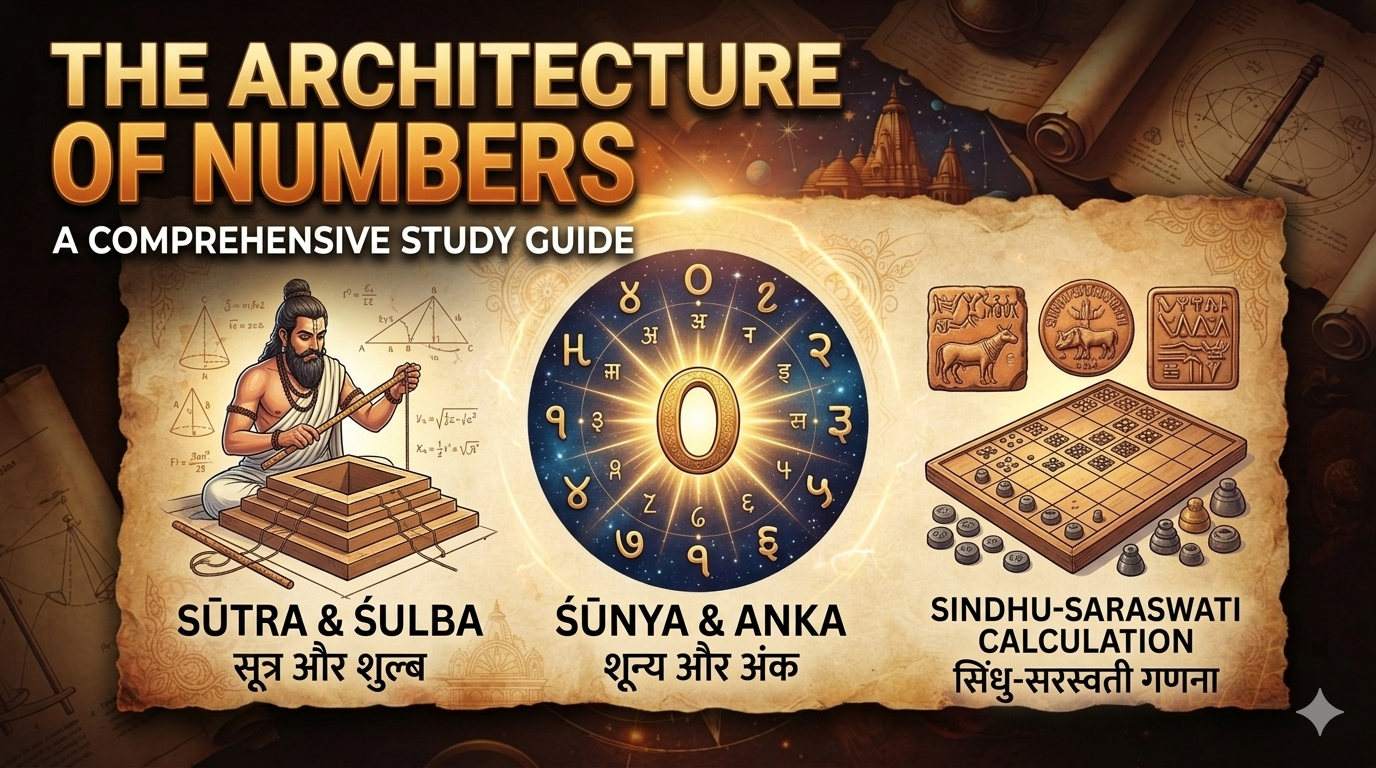
Mathematics is the universal language of science, and its foundation was profoundly shaped by the intellectual giants of ancient India. Long before the European Renaissance, Indian mathematicians were conceptualizing abstract numbers, formalizing algebraic rules, and laying the groundwork for calculus.
This study guide explores the monumental evolution of Indian mathematics, focusing on the revolutionary discovery of Zero (Shunya), the elegant Decimal Place-Value System, and the groundbreaking contributions of legendary scholars like Aryabhata, Brahmagupta, and Bhaskaracharya.
1. The Genesis of Zero (Shunya): From Philosophy to Mathematics
The concept of zero is arguably ancient India’s greatest intellectual export. While other ancient civilizations (like the Babylonians and Mayans) used zero merely as a placeholder to distinguish between numbers like 11 and 101, Indian mathematicians took the monumental leap of treating zero as a number in its own right, with its own mathematical properties.
The Philosophical Roots
The mathematical concept of zero was born from the deep Indian philosophical understanding of the universe. The Sanskrit word for zero, Shunya, translates to "void," "emptiness," or "nothingness." In Indian philosophy, the universe originates from a void and returns to it. Translating this profound philosophical concept into a mathematical symbol allowed mathematicians to perform calculations involving "nothing."
The Historical Evolution
- The Bakhshali Manuscript (c. 3rd–4th Century CE): Discovered in modern-day Pakistan, this is one of the oldest surviving mathematical manuscripts. It uses a dot (called bindu) to represent zero. Recent carbon dating confirms its ancient origins, pushing the timeline of zero's usage further back than previously thought.
- The Gwalior Inscription (876 CE): Located in the Chaturbhuj temple in Gwalior, this is the first clear, undisputed physical record of zero written as a small circle. It records the dimensions of a garden, using the number 270 (written as 27 with a small circle for zero).
- Brahmagupta’s Formalization (628 CE): While the symbol existed earlier, it was Brahmagupta who first defined the mathematical rules for operating with zero, transforming it from a mere symbol into a fully functional number (detailed in Section 4).
2. The Decimal Place-Value System: The Ultimate Mathematical Tool
Before the decimal system, civilizations used cumbersome numeral systems. The Roman numeral system (I, V, X, L, C, D, M) made basic arithmetic like multiplication or division incredibly difficult. There was no way to easily write "one million" or calculate 345×12345 \times 12345×12.
The Indian Breakthrough
Ancient Indian mathematicians developed the Base-10 Decimal Place-Value System. The genius of this system lies in two rules:
- Place Value: The value of a digit depends on its position. A '1' in the units place is 1, but in the tens place, it is 10, and in the hundreds place, it is 100.
- Nine Symbols + Zero: By using just nine symbols (1 through 9) and the concept of zero as a placeholder, any number, no matter how large, could be written simply and calculated easily.
Global Transmission
This system was documented in Sanskrit texts and eventually translated into Arabic in the 8th century. The Persian mathematician Al-Khwarizmi wrote a seminal book titled On the Calculation with Hindu Numerals (c. 825 CE). When this system reached Europe in the 12th century, it became known as the "Hindu-Arabic numeral system." The great Italian mathematician Fibonacci championed its use in Europe, replacing the Roman system and sparking the scientific and commercial revolutions of the modern world.
3. Aryabhata (476–550 CE): The Pioneer of Classical Mathematics
Aryabhata is the first major mathematician and astronomer of the classical period in India. His magnum opus, the Aryabhatiya (written in 499 CE), is a compact text that covers arithmetic, algebra, plane trigonometry, and spherical trigonometry.
Key Mathematical Contributions:
- Approximation of Pi (π\piπ): Aryabhata provided a highly accurate rational approximation for Pi. He stated:
"Add four to 100, multiply by eight, and then add 62,000. By these rules, the circumference of a circle with a diameter of 20,000 can be approximated." Mathematically: (100+4)×8+6200020000=6283220000=3.1416\frac{(100 + 4) \times 8 + 62000}{20000} = \frac{62832}{20000} = 3.141620000(100+4)×8+62000=2000062832=3.1416. This is accurate to four decimal places! He also correctly deduced that Pi is an irrational number (Asanna).
- Trigonometry: Aryabhata introduced the concept of the sine function, which he called Jya (later translated to Arabic as Jiba and eventually to English as Sine). He created the first sine table, calculating the values at intervals of 3.75 degrees.
- Algebra and Arithmetic: He provided formulas for the sum of squares and cubes of the first nnn natural numbers. He also solved indeterminate linear equations (equations with multiple variables) using a method called Kuttaka (the "pulverizer"), which was crucial in solving complex astronomical problems.
4. Brahmagupta (598–668 CE): The Rule-Maker of Algebra
If Aryabhata laid the foundation, Brahmagupta built the structure. His most famous work, the Brahmasphutasiddhanta (628 CE), is the first text in the world to formally treat zero and negative numbers as valid mathematical entities.
Key Mathematical Contributions:
- Rules of Zero and Negative Numbers: Brahmagupta defined zero as the result of subtracting a number from itself (a−a=0a - a = 0a−a=0). He laid down the fundamental rules of arithmetic with zero and negative numbers (which he called "fortunes" and "debts"):
- A debt minus zero is a debt.
- A fortune minus zero is a fortune.
- Zero minus zero is zero.
- Zero multiplied by any number is zero.
- (Note: He incorrectly stated that zero divided by zero is zero, a paradox later corrected by Bhaskara).
- Brahmagupta’s Formula: He discovered a beautiful formula to calculate the area of a cyclic quadrilateral (a four-sided figure inscribed in a circle) given the lengths of its sides (a,b,c,da, b, c, da,b,c,d). If sss is the semi-perimeter, the area is: Area=(s−a)(s−b)(s−c)(s−d)Area = \sqrt{(s-a)(s-b)(s-c)(s-d)}Area=(s−a)(s−b)(s−c)(s−d) (This is a generalization of Heron’s formula for triangles).
- Quadratic Equations: He was the first to give a clear, general solution to the quadratic equation (ax2+bx+c=0ax^2 + bx + c = 0ax2+bx+c=0), recognizing that a quadratic equation can have two roots, including negative and irrational roots.
5. Bhaskaracharya II (1114–1185 CE): The Master of Calculus Precursors
Bhaskara II, often referred to as Bhaskaracharya, was the leading mathematical and astronomical genius of the 12th century. His comprehensive treatise, the Siddhanta Shiromani ("Crown of Treatises"), is divided into four distinct parts, showcasing the vast breadth of his knowledge.
The Four Parts of Siddhanta Shiromani:
- Lilavati (Arithmetic & Geometry): Named after his daughter (according to popular legend), this section deals with definitions, arithmetic operations, fractions, interest calculations, and mensuration (measuring areas and volumes of 2D and 3D shapes). It is written in a highly poetic, accessible verse format.
- Bijaganita (Algebra): This text covers advanced algebra, including quadratic equations, indeterminate equations, and permutations/combinations.
- Grahaganita (Mathematics of the Planets): Applied astronomy and spherical trigonometry.
- Goladhyaya (Sphere and Astronomy): Detailed study of the celestial sphere and cosmology.
Key Mathematical Contributions:
- Precursors to Calculus: Bhaskara’s most astonishing contribution was his conceptualization of differential calculus, centuries before Newton and Leibniz. In his work, he discussed the concept of Tatkalika (infinitesimal time intervals) and calculated the instantaneous motion of planets. He recognized that at the highest or lowest point of a planet's orbit, its instantaneous change in position (derivative) is zero.
- Division by Zero and Infinity: While Brahmagupta struggled with dividing by zero, Bhaskara correctly deduced that dividing a finite number by an infinitesimally small number results in an infinite quantity. He conceptualized Ananta (Infinity) and noted that just as rivers merge into the ocean and lose their individual identities, all numbers merge into infinity when divided by zero, remaining unchanged even if added to or subtracted from.
- Solutions to Pell’s Equation: He provided a highly sophisticated method (the Chakravala or cyclic method) to solve indeterminate quadratic equations (like x2−ny2=1x^2 - ny^2 = 1x2−ny2=1), a problem that stumped European mathematicians until the 17th century.
6. Beyond the Big Three: Other Notable Contributions
While Aryabhata, Brahmagupta, and Bhaskara are the pillars, the Indian mathematical tradition was a continuous, evolving river of knowledge.
- Mahavira (9th Century): In his text Ganita Sara Sangraha, he systematized algebraic terms and was the first to separate astrology and astronomy from pure mathematics. He also corrected Brahmagupta’s error regarding zero, stating that a number divided by zero remains unchanged (an early conceptualization of infinity).
- Sridharacharya (10th–11th Century): He formulated the standard quadratic formula used in schools today. He also wrote extensively on the extraction of square and cube roots.
- The Kerala School of Mathematics (14th–16th Century): Founded by Madhava of Sangamagrama, this school made mind-boggling advancements in infinite series. Madhava discovered the infinite series for sine, cosine, and arctangent (now known in the West as the Gregory-Leibniz series) over 200 years before James Gregory and Gottfried Leibniz. They effectively laid the true foundations of mathematical analysis and calculus.
7. The Global Legacy: How Indian Math Shaped the Modern World
The transmission of Indian mathematics to the rest of the world is a story of cross-cultural collaboration.
- The Arab Translation Movement (8th–9th Century): Indian texts like the Brahmasphutasiddhanta were translated into Arabic in Baghdad. Scholars like Al-Khwarizmi and Al-Kindi studied them deeply. Al-Khwarizmi’s synthesis of Indian numerals and Greek geometry gave birth to the field of Algebra (from his book Al-Jabr).
- The European Awakening (12th–13th Century): The Arabic texts, including the Hindu-Arabic numeral system, reached Europe via Spain and Italy. Fibonacci’s book Liber Abaci (1202 CE) introduced these numerals to European merchants and scientists, replacing the Roman system and enabling the complex accounting required for the Renaissance and the Age of Discovery.
- The Scientific Revolution: Without the decimal system and the concept of zero, the complex calculations required by Kepler, Galileo, and Newton would have been practically impossible. The digital age we live in today—based entirely on binary code (0s and 1s)—is a direct philosophical and mathematical descendant of the Indian concept of Shunya.
📝 Quick Revision Checklist (For Exams & VVM)
- Shunya (Zero): Evolved from a philosophical concept of "void" to a mathematical number. First physical record of the circular zero is in the Gwalior inscription (876 CE).
- Decimal System: Base-10 place-value system. Transmitted to Europe via Arabs; known as Hindu-Arabic numerals.
- Aryabhata (476–550 CE): Wrote Aryabhatiya. Approximated π\piπ as 3.1416. Introduced Jya (Sine). Invented the Kuttaka method.
- Brahmagupta (598–668 CE): Wrote Brahmasphutasiddhanta. First to define rules for zero and negative numbers. Discovered the formula for the area of a cyclic quadrilateral.
- Bhaskara II (1114–1185 CE): Wrote Siddhanta Shiromani (divided into Lilavati, Bijaganita, Grahaganita, Goladhyaya). Precursor to differential calculus (Tatkalika). Conceptualized Infinity (Ananta).
- Kerala School: Madhava discovered infinite series for trigonometric functions centuries before Europe.
- Global Impact: Al-Khwarizmi introduced Indian numerals to the Arab world; Fibonacci introduced them to Europe, enabling the modern scientific and digital revolutions.
A Final Thought for Young Mathematicians
The history of ancient Indian mathematics teaches us that true scientific progress requires both logical rigor and imaginative leaps. The scholars of ancient India did not just calculate the physical world around them; they had the imagination to conceptualize "nothingness" (zero) and "infinity" (Ananta).
As you study these concepts, remember that you are learning a language that was forged by some of the greatest minds in human history. Embrace the logic, appreciate the beauty of the numbers, and let the legacy of Aryabhata, Brahmagupta, and Bhaskara inspire your own scientific journey!
If you found this study guide helpful, bookmark it for your exam revisions! Let us know in the comments which ancient mathematician’s work fascinates you the most, or if you’d like a deep-dive study guide on the Kerala School of Mathematics next!
Keywords : ancient aryabhata brahmagupta century concept first his indian into its like mathematical mathematics number numbers place system that this zero
🔔 हमारे YouTube चैनल को सब्सक्राइब करें:
👉 https://www.youtube.com/channel/UC76hj0iZcKkiW1YizHs0n2Q/
📘 Facebook Page:
👉 https://www.facebook.com/DigiTatvaPlus
🌿 वेबसाइट विजिट करें:
👉 https://www.bhaktipulse.com/
👉 https://www.bhaktipulse.com/video
✨ Guest Post Invitation – Share Your Divine Wisdom
🙏 Welcome to BhaktiPulse – your spiritual companion for Aarti, Chalisa, Bhajan, Mantra, and divine stories.
🌸 Do you have spiritual knowledge, devotional content, experiences, or stories that can inspire others?
📖 We warmly invite you to contribute your valuable content and become a part of our growing spiritual community.
✨ Your content may include:
- 🪔 Aarti, Chalisa, Mantra, Bhajan
- 📜 Spiritual stories & life lessons
- 🔍 Unknown facts & scientific reasons in Sanatan Dharma
- 🌿 Ayurveda, rituals, and traditions
💡 If your content aligns with our vision, we will proudly feature it on BhaktiPulse.
📩 Submit your content or contact us here:
👉 https://www.bhaktipulse.com/contact.php
🌼 Let your words spread devotion, ज्ञान, and positivity to the world.
🙏 Join us in this divine journey!
💬 Comments
Approved Comments