Ancient Indian Science: A Brief Study Guide to Ayurveda, Astronomy, and Metallurgy
41 Visited Vidyarthi Vigyan Manthan (VVM) • Updated: Saturday, 18 July 2026
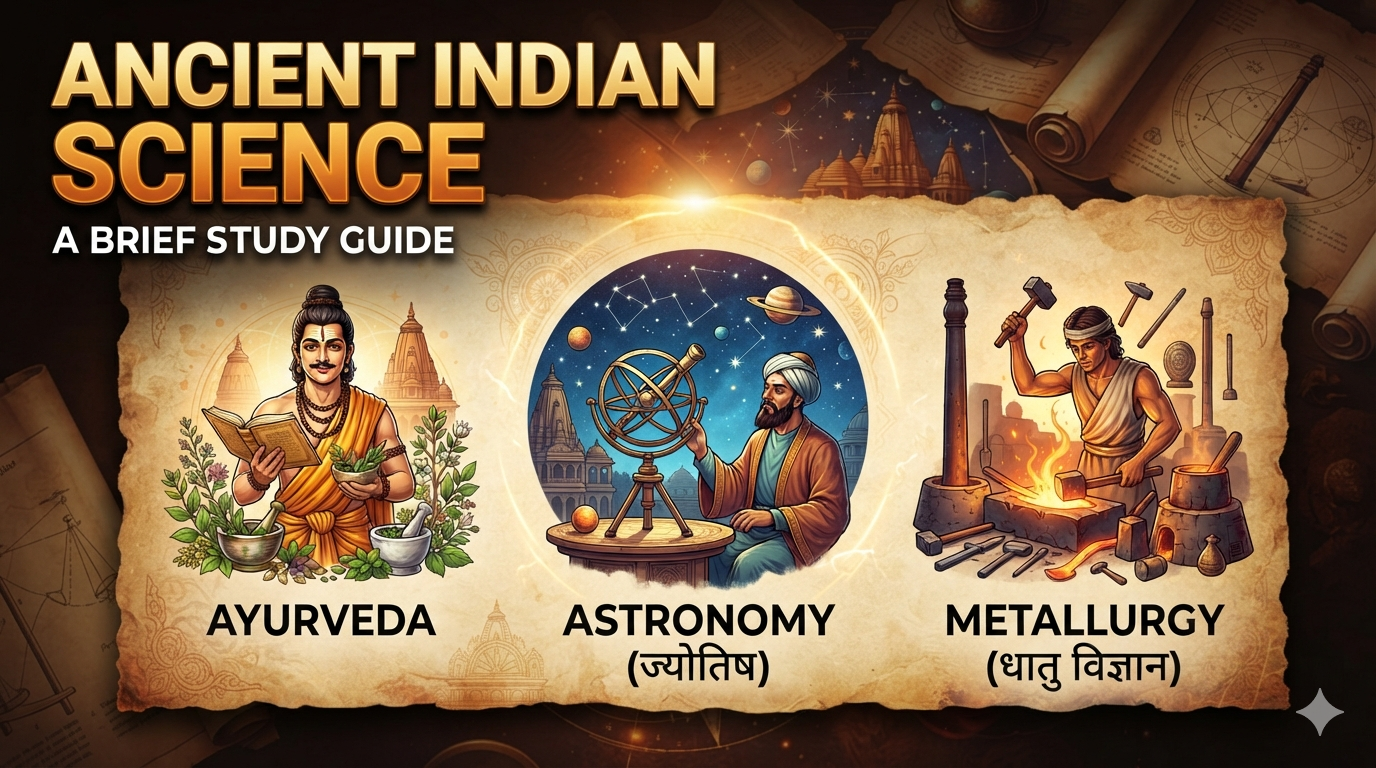
Ancient India was a global hub of scientific innovation. Long before the modern scientific method was formalized, Indian scholars were making systematic, empirical, and highly advanced discoveries in medicine, space, and materials science.
This brief study guide covers three foundational pillars of ancient Indian science: Ayurveda, Astronomy, and Metallurgy.
1. Ayurveda: The Science of Life
Ayurveda ("Ayur" = life, "Veda" = knowledge) is one of the world’s oldest holistic healing systems. It is based on the balance of three fundamental bodily humors or Doshas: Vata (air/space), Pitta (fire/water), and Kapha (earth/water).
Key Texts and Contributors:
- Charaka Samhita (c. 2nd Century BCE):
- Focus: Internal medicine (Kayachikitsa), diagnosis, and prevention.
- Key Contributions: Authored by the sage Charaka, it details the physiology of the human body, the concept of digestion and metabolism, and the use of hundreds of medicinal plants (like Ashwagandha and Turmeric). It emphasizes that health is a balance of body, mind, and spirit.
- Sushruta Samhita (c. 6th Century BCE):
- Focus: Surgery (Shalya Tantra) and anatomy.
- Key Contributions: Sage Sushruta is widely regarded as the "Father of Surgery." The text describes over 300 surgical procedures and 120+ surgical instruments. It famously details early forms of rhinoplasty (plastic surgery of the nose), cataract surgery, and the importance of practical training using models (like fruits and dead animals).
2. Khagol Vigyan: Ancient Indian Astronomy
Ancient Indian astronomy was deeply intertwined with mathematics. It was not just about observing the stars, but about calculating planetary motions, eclipses, and time with remarkable precision.
Key Figures and Texts:
- Aryabhata (476–550 CE):
- Text: Aryabhatiya.
- Key Contributions: Proposed that the Earth rotates on its own axis (explaining the apparent movement of stars). He accurately calculated the value of Pi (π), explained the scientific causes of solar and lunar eclipses, and laid the groundwork for the concept of zero.
- Varahamihira (6th Century CE):
- Text: Pancha Siddhantika and Brihat Samhita.
- Key Contributions: Synthesized five earlier astronomical traditions. His work also contained early insights into meteorology, groundwater detection, and astrology as it was understood then.
- Bhaskara II (12th Century CE):
- Text: Siddhanta Shiromani (which includes the Lilavati on arithmetic and Bijaganita on algebra).
- Key Contributions: Made pioneering contributions to calculus concepts, gravity (Gurutvakarshan), and the accurate calculation of the Earth's orbital period around the Sun.
3. Dhatu Vigyan: Ancient Indian Metallurgy
Ancient Indian metallurgists possessed advanced knowledge of ore extraction, smelting, and alloying. Their techniques produced metals of such high quality that they baffled later scientists.
Key Achievements:
- The Iron Pillar of Delhi (c. 4th–5th Century CE, Gupta Period):
- Standing over 7 meters tall and weighing more than 6 tons, this pillar is famous for its extraordinary resistance to corrosion (rust) despite being exposed to the elements for over 1,600 years. This was achieved through a high-phosphorus, low-sulfur iron composition and a protective passive layer of "misawite."
- Wootz Steel (Crucible Steel):
- Originating in South India (around 300 BCE), Wootz steel was produced by heating iron with wood and specific leaves in a sealed clay crucible. This created ultra-high-carbon steel, famous for its distinctive watery pattern and incredible sharpness. It was highly sought after globally and became the legendary "Damascus Steel" of the Middle East.
- Zinc Distillation (Zawar Mines, Rajasthan):
- India was the first to successfully distill zinc on a commercial scale (c. 9th–12th Century CE). Because zinc boils at a lower temperature than it melts, it was historically difficult to extract. Ancient Indian metallurgists invented a downward distillation process to capture zinc vapor, a technique centuries ahead of Europe.
📝 Quick Revision Checklist (For Exams)
- Charaka Samhita = Internal Medicine & Holistic Health.
- Sushruta Samhita = Surgery, Rhinoplasty, Surgical Instruments.
- Aryabhata = Earth's rotation, Eclipse science, Aryabhatiya.
- Varahamihira = Pancha Siddhantika, synthesized 5 astronomical schools.
- Iron Pillar of Delhi = Rust-resistant, Gupta Period.
- Wootz Steel = Crucible steel, origin of Damascus steel, South India.
- Zinc Distillation = First achieved in Zawar, Rajasthan.
Why This Matters Today
The scientific temper of ancient India was rooted in observation, experimentation, and documentation. From the surgical principles of Sushruta that influence modern plastic surgery, to the corrosion-resistant secrets of the Iron Pillar that modern material scientists still study, this heritage is a testament to India’s enduring legacy of innovation.
Use this guide as a quick reference for your studies, competitive exams, or general knowledge enrichment. Jai Vigyan!
Keywords : ancient astronomy ayurveda century contributions earth india indian iron key knowledge samhita science scientific steel surgery sushruta that this zinc
🔔 हमारे YouTube चैनल को सब्सक्राइब करें:
👉 https://www.youtube.com/channel/UC76hj0iZcKkiW1YizHs0n2Q/
📘 Facebook Page:
👉 https://www.facebook.com/DigiTatvaPlus
🌿 वेबसाइट विजिट करें:
👉 https://www.bhaktipulse.com/
👉 https://www.bhaktipulse.com/video
✨ Guest Post Invitation – Share Your Divine Wisdom
🙏 Welcome to BhaktiPulse – your spiritual companion for Aarti, Chalisa, Bhajan, Mantra, and divine stories.
🌸 Do you have spiritual knowledge, devotional content, experiences, or stories that can inspire others?
📖 We warmly invite you to contribute your valuable content and become a part of our growing spiritual community.
✨ Your content may include:
- 🪔 Aarti, Chalisa, Mantra, Bhajan
- 📜 Spiritual stories & life lessons
- 🔍 Unknown facts & scientific reasons in Sanatan Dharma
- 🌿 Ayurveda, rituals, and traditions
💡 If your content aligns with our vision, we will proudly feature it on BhaktiPulse.
📩 Submit your content or contact us here:
👉 https://www.bhaktipulse.com/contact.php
🌼 Let your words spread devotion, ज्ञान, and positivity to the world.
🙏 Join us in this divine journey!
💬 Comments
Approved Comments