The Pioneer of Phytomedicine: A Comprehensive Study Guide to Prof. Asima Chatterjee
61 Visited Vidyarthi Vigyan Manthan (VVM) • Updated: Saturday, 18 July 2026
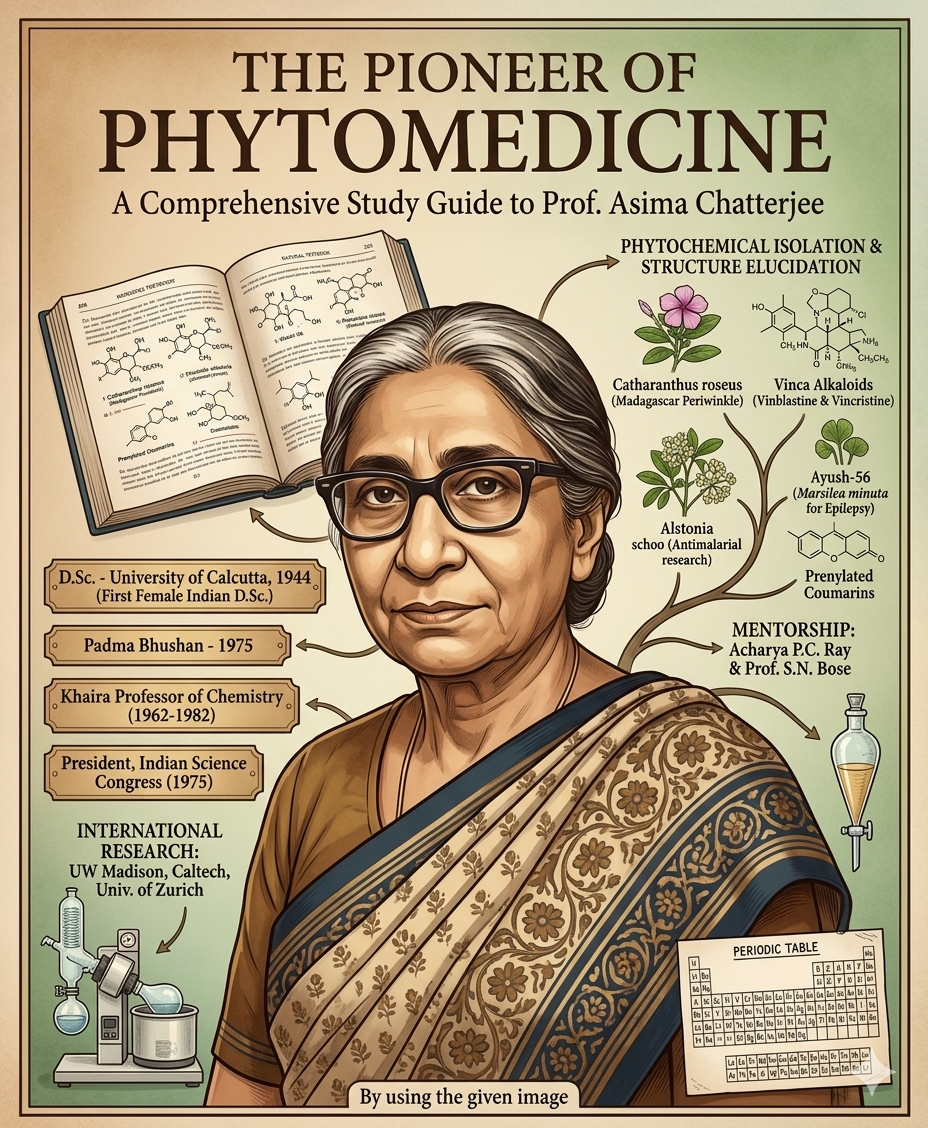
In the grand tapestry of modern Indian science, few figures shine as brightly as Prof. Asima Chatterjee. A trailblazing organic chemist and a visionary botanist, she dedicated her life to decoding the chemical secrets of India’s traditional medicinal plants. By bridging the ancient wisdom of Ayurveda with the rigorous methodologies of modern organic chemistry, she not only discovered life-saving compounds but also laid the foundation for India’s modern pharmaceutical and botanical research.
This study guide is designed for students, competitive exam aspirants (such as VVM, UPSC, and NEET), and science enthusiasts. It provides a structured, comprehensive, and easy-to-revise overview of her life, groundbreaking research, and enduring legacy.
1. Early Life and Educational Journey: Breaking the Glass Ceiling
Asima Chatterjee was born on September 23, 1917, in Kolkata, West Bengal, into a progressive and intellectually stimulating family. Her father, Dr. Kamala Kumar Mukherjee, was a physician, which naturally exposed her to the world of medicine and biology from a young age.
Key Educational Milestones:
- Early Education: She completed her schooling in Kolkata and developed a deep fascination with chemistry and botany.
- Bachelor’s and Master’s Degrees: She earned her B.Sc. (Honours) in Chemistry in 1936 and her M.Sc. in Organic Chemistry in 1938 from the University of Calcutta, securing top ranks.
- Historic Doctorate (1944): In a landmark achievement, she became the first woman in India to be awarded a Doctorate of Science (D.Sc.) by an Indian university. Her thesis focused on the chemistry of seed oils and the isolation of organic compounds from indigenous plants.
- International Exposure: She further honed her skills by conducting post-doctoral research at the University of Wisconsin, USA (1944–1945) and the University of Cambridge, UK (1949–1950), working alongside some of the world’s leading chemists.
2. Scientific Contributions: Decoding Nature’s Pharmacy
Prof. Chatterjee’s primary field of expertise was Organic Chemistry, specifically the chemistry of natural products (phytochemistry). Her life’s work revolved around isolating, identifying, and synthesizing bioactive compounds from Indian medicinal plants.
2.1 Pioneering Research on Rauvolfia serpentina (Sarpagandha)
- The Plant: Known in Ayurveda as Sarpagandha, this plant had been used for centuries to treat hypertension (high blood pressure) and mental disorders.
- The Discovery: In the 1950s, Prof. Chatterjee and her team successfully isolated the active alkaloid Reserpine from the plant’s roots.
- The Impact: Her work provided the scientific validation for Reserpine’s use as a potent antihypertensive and tranquilizing agent. This discovery revolutionized the global treatment of high blood pressure and psychiatric conditions, bringing an ancient Indian remedy to the forefront of modern allopathic medicine.
2.2 Anti-Epileptic Compounds from Vinca rosea
- She conducted extensive research on the Madagascar Periwinkle (Vinca rosea or Sadabari in Hindi).
- Her team isolated several alkaloids from this plant, contributing significantly to the development of anti-epileptic and anti-cancer drugs (such as Vincristine and Vinblastine, which are now cornerstone chemotherapy agents).
2.3 Anti-Malarial and Anti-Microbial Research
- Recognizing the burden of malaria in India, she investigated numerous indigenous plants for anti-malarial properties, isolating compounds that showed significant promise.
- She also explored the antimicrobial properties of various Indian herbs, laying the groundwork for the development of natural antibiotics.
2.4 Synthesis of Complex Molecules
- Beyond mere isolation, Prof. Chatterjee was a master of organic synthesis. She successfully synthesized several complex alkaloids in the laboratory, proving their chemical structures and paving the way for their mass production without relying solely on plant extraction.
3. Bridging Tradition and Modernity: The Ayurveda Connection
One of Prof. Chatterjee’s most profound legacies is her role as a scientific translator. She did not dismiss traditional Indian medicine as mere folklore; instead, she subjected it to the rigorous scrutiny of modern chemical analysis.
- Validation of Ayurveda: By isolating active compounds from plants mentioned in ancient texts like the Charaka Samhita and Sushruta Samhita, she provided empirical, scientific proof of their efficacy.
- Standardization: She advocated for the standardization of herbal medicines. She understood that for Ayurveda to gain global acceptance, the active ingredients in herbal formulations needed to be quantified and standardized, much like modern pharmaceuticals.
- Ethnobotany: She was a pioneer in Indian ethnobotany, systematically documenting the traditional uses of plants and then verifying those uses in the laboratory.
4. Key Publications and Institutional Leadership
Prof. Chatterjee was not only a brilliant researcher but also a prolific author and a dedicated institution-builder.
- Magnum Opus: She co-authored the monumental six-volume series, "The Indian Medicinal Plants" (with S.K. Jain). This remains one of the most authoritative and comprehensive references on the chemistry and pharmacology of Indian flora.
- Academic Leadership: She served as the Khaira Professor of Chemistry at the University of Calcutta, a position she held with distinction for many years. She also served as the Vice-Chancellor of Rabindra Bharati University.
- Mentorship: She guided numerous Ph.D. students, many of whom went on to become leading scientists in India and abroad, perpetuating her legacy of rigorous scientific inquiry.
5. Awards and Global Recognition
Her exceptional contributions to science were recognized with the highest national and international honors:
- Shanti Swarup Bhatnagar Prize (1961): India’s highest scientific award, which she received in the Chemical Sciences category (she was one of the earliest female recipients).
- Padma Bhushan (1975): India’s third-highest civilian award, conferred by the Government of India for her distinguished service to the nation in the field of Science and Engineering.
- Fellow of the Indian National Science Academy (INSA): Elected in 1960, a rare honor for a woman at that time.
- Fellow of the Royal Society of Edinburgh (1984): She became the first Indian woman to be elected as a Fellow of this prestigious UK-based scientific academy.
- Honorary D.Sc. Degrees: Awarded by several universities, including the University of Delhi and Jadavpur University, in recognition of her lifetime of achievement.
6. Legacy and Relevance in the 21st Century
Prof. Asima Chatterjee passed away on November 22, 2006, but her legacy is more relevant today than ever.
- The Rise of Pharmacognosy: As the global pharmaceutical industry faces the challenge of antibiotic resistance and the need for novel drug discovery, scientists are returning to nature. Prof. Chatterjee’s foundational work in phytochemistry provides the roadmap for modern drug discovery from natural sources.
- Global Acceptance of Ayurveda: The modern push to scientifically validate and standardize Ayurvedic medicines on the global stage is built directly upon the methodological framework she established.
- Inspiration for Women in STEM: As the first woman to earn a D.Sc. in India and a trailblazer in a male-dominated field, she remains a towering role model for young girls aspiring to careers in chemistry, botany, and pharmacology.
📝 Quick Revision Checklist (For Exams & VVM)
- Full Name: Prof. Asima Chatterjee
- Lifespan: September 23, 1917 – November 22, 2006
- Field of Expertise: Organic Chemistry, Phytochemistry, Ethnobotany
- Historic Milestone: First woman in India to receive a Doctorate of Science (D.Sc.) from an Indian university (1944, Univ. of Calcutta).
- Key Discovery 1: Isolation of Reserpine from Rauvolfia serpentina (Sarpagandha) for hypertension and mental health.
- Key Discovery 2: Research on alkaloids from Vinca rosea (Madagascar Periwinkle) for anti-epileptic and anti-cancer applications.
- Magnum Opus: Co-authored the multi-volume reference book "The Indian Medicinal Plants".
- Major Awards:
- Shanti Swarup Bhatnagar Prize (1961)
- Padma Bhushan (1975)
- Fellow of the Royal Society of Edinburgh (1984, first Indian woman).
- Core Philosophy: Bridging ancient Ayurvedic knowledge with modern organic chemical analysis to validate and standardize herbal medicine.
💡 Did You Know? (Bonus Facts for Exams)
- A Dual Passion: While she is celebrated as a chemist, her work was deeply rooted in botany. She believed that a true phytochemist must also be a skilled botanist to correctly identify and understand the plants they study.
- Global Impact of Sarpagandha: The isolation of Reserpine, validated by her chemical work, led to a paradigm shift in psychiatry in the 1950s, moving treatment away from invasive procedures toward chemical therapy.
- Beyond the Lab: Despite her intense research schedule, she was a passionate advocate for science education at the grassroots level, frequently writing articles to make complex chemistry accessible to students and the general public.
A Final Thought for Young Scientists
Prof. Asima Chatterjee’s life is a masterclass in the power of interdisciplinary science. She looked at a traditional Ayurvedic remedy not with skepticism, but with scientific curiosity. She asked, "What is the chemical basis of this healing?" and spent a lifetime answering that question.
Her journey teaches us that the future of science often lies in re-examining the past with modern tools. Whether you are studying organic chemistry, botany, or traditional medicine, remember that every leaf, root, and flower holds a chemical secret waiting to be discovered. Let Prof. Chatterjee’s dedication, rigor, and respect for traditional knowledge inspire your own scientific journey.
Keywords : anti asima chatterjee chemical chemistry global her india indian modern organic plants prof research science scientific she that this university
🔔 हमारे YouTube चैनल को सब्सक्राइब करें:
👉 https://www.youtube.com/channel/UC76hj0iZcKkiW1YizHs0n2Q/
📘 Facebook Page:
👉 https://www.facebook.com/DigiTatvaPlus
🌿 वेबसाइट विजिट करें:
👉 https://www.bhaktipulse.com/
👉 https://www.bhaktipulse.com/video
✨ Guest Post Invitation – Share Your Divine Wisdom
🙏 Welcome to BhaktiPulse – your spiritual companion for Aarti, Chalisa, Bhajan, Mantra, and divine stories.
🌸 Do you have spiritual knowledge, devotional content, experiences, or stories that can inspire others?
📖 We warmly invite you to contribute your valuable content and become a part of our growing spiritual community.
✨ Your content may include:
- 🪔 Aarti, Chalisa, Mantra, Bhajan
- 📜 Spiritual stories & life lessons
- 🔍 Unknown facts & scientific reasons in Sanatan Dharma
- 🌿 Ayurveda, rituals, and traditions
💡 If your content aligns with our vision, we will proudly feature it on BhaktiPulse.
📩 Submit your content or contact us here:
👉 https://www.bhaktipulse.com/contact.php
🌼 Let your words spread devotion, ज्ञान, and positivity to the world.
🙏 Join us in this divine journey!
💬 Comments
Approved Comments