The Architects of Discovery: A Comprehensive Study Guide to the Greatest Scientists of India
30 Visited Vidyarthi Vigyan Manthan (VVM) • Updated: Saturday, 18 July 2026
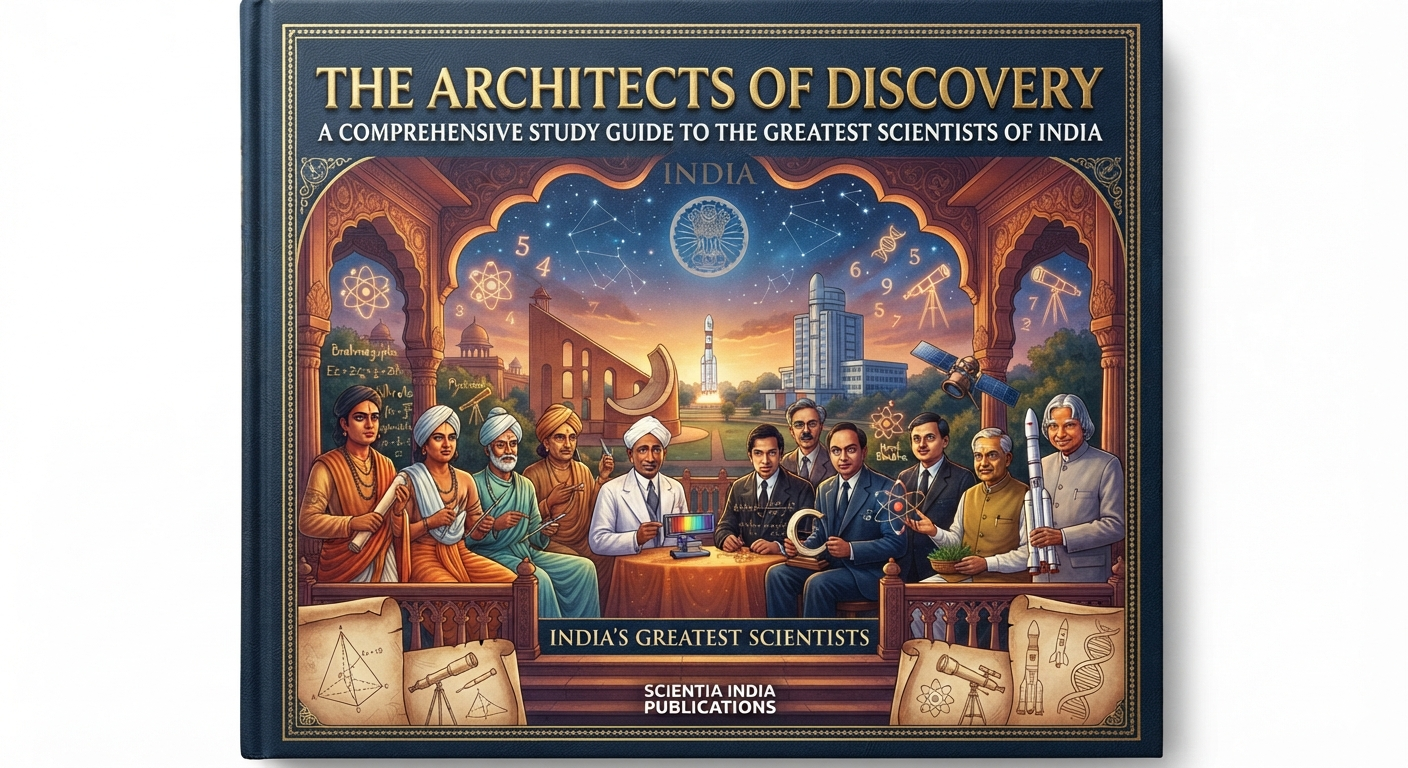
India’s scientific heritage is a continuum that stretches from the ancient conceptualization of zero and atomic theory to modern breakthroughs in space exploration, nuclear physics, and biotechnology. The architects of this legacy are the brilliant minds who not only expanded the boundaries of human knowledge but also applied science to solve India’s most pressing challenges.
This comprehensive study guide is designed for students, competitive exam aspirants (VVM, UPSC, SSC, NEET), and science enthusiasts. It categorizes India’s greatest scientists by their fields, providing a structured, easy-to-revise overview of their lives, groundbreaking contributions, and enduring legacies.
1. The Pioneers of Physics and Mathematics
These visionary thinkers laid the foundational frameworks for modern physics and mathematics, earning global recognition and fundamentally altering our understanding of the universe.
Sir C.V. Raman (1888–1970)
- Title: Father of Modern Physics in India.
- Key Contribution: Discovered the Raman Effect (February 28, 1928), which describes the change in the wavelength of light that occurs when a light beam is deflected by molecules. This proved the quantum nature of light.
- Major Awards: Nobel Prize in Physics (1930) – the first Asian to receive a Nobel Prize in any branch of science. Knighted in 1929.
- Legacy: Founded the Raman Research Institute (RRI) in Bangalore. February 28 is celebrated annually as National Science Day in India to commemorate this discovery.
Srinivasa Ramanujan (1887–1920)
- Title: The Man Who Knew Infinity.
- Key Contribution: Made extraordinary contributions to mathematical analysis, number theory, infinite series, and continued fractions, almost entirely without formal training. He compiled nearly 3,900 results (mostly identities and equations).
- Famous Fact: The number 1729 is known as the Hardy-Ramanujan Number (or Taxicab number), as it is the smallest number expressible as the sum of two cubes in two different ways (13+1231^3 + 12^313+123 and 93+1039^3 + 10^393+103).
- Legacy: His "Lost Notebook," discovered after his death, continues to inspire mathematicians today. His birthday, December 22, is celebrated as National Mathematics Day.
Satyendra Nath Bose (1894–1974)
- Title: The Master of Quantum Statistics.
- Key Contribution: Developed Bose-Einstein Statistics in 1924, which describes the behavior of particles that do not obey the Pauli Exclusion Principle. He sent his paper to Albert Einstein, who translated it into German and got it published.
- Legacy: Particles that follow this statistical behavior are named Bosons in his honor. The Higgs Boson (discovered in 2012) is named partly after him. He also co-founded the Indian Statistical Institute (ISI) and served as the Vice-Chancellor of Visva-Bharati University.
2. The Architects of India’s Nuclear and Space Programs
Post-independence, these scientists built India’s strategic and technological infrastructure from the ground up, ensuring national self-reliance.
Dr. Homi J. Bhabha (1909–1966)
- Title: Father of the Indian Nuclear Program.
- Key Contribution: Formulated the Three-Stage Nuclear Power Programme to utilize India’s vast thorium reserves for long-term energy independence. He was the chief architect of India's nuclear research and development.
- Institutions Founded: Tata Institute of Fundamental Research (TIFR, 1945) and the Bhabha Atomic Research Centre (BARC, originally Trombay Atomic Energy Establishment, 1954).
- Legacy: His vision ensured that India developed nuclear technology primarily for peaceful energy generation, while maintaining the capability for national security.
Dr. Vikram Sarabhai (1919–1971)
- Title: Father of the Indian Space Program.
- Key Contribution: Convincing the government that space technology was vital for a developing nation, not for prestige, but for practical applications like communication, remote sensing, and weather forecasting.
- Institutions Founded: Physical Research Laboratory (PRL, 1947), Indian National Committee for Space Research (INCOSPAR, 1962, which later became ISRO in 1969), and the Indian Institute of Management Ahmedabad (IIMA).
- Legacy: Initiated India’s first satellite launch program and established the Thumba Equatorial Rocket Launching Station (TERLS).
3. The Titans of Biology, Chemistry, and Agriculture
These scientists focused on improving the quality of life, food security, and health through applied sciences.
Sir Jagadish Chandra Bose (1858–1937)
- Title: Pioneer of Radio and Microwave Optics, and Plant Neurobiology.
- Key Contribution:
- Physics: Proved that plants and animals have similar responses to electrical stimuli. He invented the Crescograph, a device to measure plant growth at microscopic levels.
- Radio Waves: He was the first to use semiconductor junctions to detect radio waves, inventing the "coherer" before Marconi, though he did not patent it, believing science should be free for all.
- Legacy: Founded the Bose Institute in Kolkata (1917), India’s first interdisciplinary research center.
Acharya Prafulla Chandra Ray (1861–1944)
- Title: Father of Indian Chemistry.
- Key Contribution: Discovered Mercurous Nitrite in 1896, a highly stable compound that defied existing chemical theories of the time. He authored the seminal two-volume work, A History of Hindu Chemistry.
- Legacy: Founded Bengal Chemicals & Pharmaceuticals in 1892, India’s first indigenous pharmaceutical company, to reduce dependence on British imports. He was also a passionate educator and nationalist.
Dr. M.S. Swaminathan (1925–2023)
- Title: Father of the Green Revolution in India.
- Key Contribution: Led the introduction and development of High-Yielding Varieties (HYVs) of wheat and rice in the 1960s. His work, combined with improved irrigation and fertilizer use, transformed India from a food-deficit nation reliant on imports into a food-surplus, self-reliant nation.
- Legacy: Founded the M.S. Swaminathan Research Foundation (MSSRF). He later championed the "Evergreen Revolution," advocating for sustainable, eco-friendly agriculture that protects soil health and farmer livelihoods.
Dr. Verghese Kurien (1921–2012)
- Title: Father of the White Revolution.
- Key Contribution: Architect of Operation Flood (launched in 1970), the world’s largest agricultural dairy development program. He established the "Anand Pattern" of cooperative dairy development.
- Institutions Founded: National Dairy Development Board (NDDB) and the Gujarat Cooperative Milk Marketing Federation (GCMMF), which markets the famous Amul brand.
- Legacy: Made India the largest producer of milk in the world, empowering millions of rural farmers (especially women) and ensuring nutritional security.
4. The Guardians of Defense and Modern Technology
These scientists ensured India’s strategic autonomy and pushed the boundaries of modern engineering.
Dr. A.P.J. Abdul Kalam (1931–2015)
- Title: Missile Man of India; People’s President.
- Key Contribution: Played a pivotal organizational, technical, and political role in India’s Pokhran-II nuclear tests (1998). He directed the Integrated Guided Missile Development Programme (IGMDP), which produced the Prithvi, Agni, Akash, Trishul, and Nag missiles.
- Space Contribution: Project Director of India’s first indigenous Satellite Launch Vehicle (SLV-III), which successfully deployed the Rohini satellite in 1980.
- Legacy: Served as the 11th President of India (2002–2007). His books, like Wings of Fire and Ignited Minds, continue to inspire millions of young Indians. His birthday, October 15, is celebrated as World Students' Day.
Dr. Tessy Thomas (Born 1963)
- Title: Missile Woman of India.
- Key Contribution: She is the first woman scientist to head a major missile project in India. She served as the Project Director for the Agni-IV intermediate-range ballistic missile and played a crucial role in the Agni-V program.
- Legacy: Broke gender barriers in India’s highly secretive and male-dominated defense research sector, proving that women can lead complex, high-stakes engineering projects.
Prof. U.R. Rao (1932–2017)
- Title: Father of Indian Satellite Technology.
- Key Contribution: Played a key role in the development of India’s satellite program. He was the driving force behind the INSAT (Indian National Satellite) system, which revolutionized telecommunications, broadcasting, and meteorology in India.
- Legacy: Served as the Chairman of ISRO (1984–1994) and was the first Indian to be inducted into the Satellite Hall of Fame in Washington, D.C. (2016).
5. Pioneering Women in Indian Science
Beyond those previously highlighted (like Anna Mani, Rohini Godbole, and Asima Chatterjee), these women broke formidable barriers:
- Dr. Janaki Ammal (1897–1984): A pioneering cytogeneticist. She is best known for her work on sugarcane breeding, which helped create a high-yielding, disease-resistant variety that boosted the Indian sugar industry. She also worked on the ethnobotany of medicinal plants.
- Dr. Kamala Sohonie (1911–1998): The first Indian woman to receive a PhD in a scientific discipline (Biochemistry, from Cambridge University). She is renowned for her research on Neera (palm tree sap), proving it to be a highly nutritious supplement that could combat malnutrition in rural India.
📝 Quick Revision Checklist (For Exams & VVM)
|
Scientist |
Title / Field |
Key Contribution / Discovery |
Major Award / Recognition |
|---|---|---|---|
|
C.V. Raman |
Physics |
Raman Effect (Light scattering) |
Nobel Prize (1930) |
|
S. Ramanujan |
Mathematics |
Infinite series, Mock theta functions, 1729 |
Fellow of Royal Society (1918) |
|
S.N. Bose |
Physics |
Bose-Einstein Statistics, Bosons |
Padma Vibhushan (1954) |
|
Homi J. Bhabha |
Nuclear Physics |
3-Stage Nuclear Program, TIFR, BARC |
Padma Bhushan (1954) |
|
Vikram Sarabhai |
Space Science |
Founded INCOSPAR (later ISRO), PRL |
Padma Bhushan (1966), Padma Vibhushan (1972) |
|
J.C. Bose |
Biophysics / Radio |
Crescograph, Plant response to stimuli |
Fellow of Royal Society (1920) |
|
P.C. Ray |
Chemistry |
Discovery of Mercurous Nitrite, Bengal Chemicals |
Knight Bachelor (1919) |
|
M.S. Swaminathan |
Agriculture |
Green Revolution (HYV seeds) |
First World Food Prize (1987) |
|
Verghese Kurien |
Dairy / Agriculture |
White Revolution (Operation Flood), Amul |
Padma Vibhushan (1999) |
|
A.P.J. Abdul Kalam |
Aerospace / Defense |
IGMDP (Agni, Prithvi), SLV-III, Pokhran-II |
Bharat Ratna (1997) |
|
Tessy Thomas |
Defense Technology |
Project Director, Agni-IV Missile |
Lal Bahadur Shastri National Award |
|
U.R. Rao |
Satellite Tech |
INSAT System, ISRO Chairman |
Padma Bhushan (1984) |
💡 Did You Know? (Bonus Facts for Exams)
- The Unpatented Genius: J.C. Bose refused to patent his inventions (like the coherer), believing that knowledge should be freely available to humanity. Guglielmo Marconi later used similar principles to build his wireless telegraphy system and won the Nobel Prize.
- A Shared Honor: The Higgs Boson particle, discovered at CERN in 2012, is named after Peter Higgs and Satyendra Nath Bose, making Bose one of the very few scientists to have a fundamental particle named after him.
- The Taxicab Epiphany: When G.H. Hardy visited a sick Ramanujan in the hospital, Hardy mentioned he arrived in taxi number 1729, calling it a "dull number." Ramanujan instantly replied that it was, in fact, a very interesting number because it is the smallest number expressible as the sum of two cubes in two different ways.
- From Milk to Missiles: Dr. Verghese Kurien (White Revolution) and Dr. A.P.J. Abdul Kalam (Missile Man) were both awarded the Bharat Ratna, India’s highest civilian honor, highlighting that nation-building requires both agricultural self-reliance and strategic defense.
A Final Thought for Young Scientists
The story of India’s scientists is not just a list of dates, discoveries, and awards. It is a narrative of resilience, resourcefulness, and a deep commitment to societal good.
Whether it was Ramanujan finding beauty in numbers, Swaminathan ensuring no Indian went to bed hungry, Kalam dreaming of a developed nation, or Tessy Thomas breaking glass ceilings in defense labs, these scientists shared a common trait: they used science not just for personal glory, but as a tool for national empowerment.
As you prepare for your exams and your own scientific journey, remember that you are standing on the shoulders of these giants. The next great discovery—whether in quantum computing, climate science, or space exploration—could very well come from your mind.
Stay curious, stay rigorous, and let the legacy of India’s scientific pioneers ignite your own passion for discovery!
Keywords : bose contribution first founded his india indian key legacy national nuclear number physics research science scientists space that title which
🔔 हमारे YouTube चैनल को सब्सक्राइब करें:
👉 https://www.youtube.com/channel/UC76hj0iZcKkiW1YizHs0n2Q/
📘 Facebook Page:
👉 https://www.facebook.com/DigiTatvaPlus
🌿 वेबसाइट विजिट करें:
👉 https://www.bhaktipulse.com/
👉 https://www.bhaktipulse.com/video
✨ Guest Post Invitation – Share Your Divine Wisdom
🙏 Welcome to BhaktiPulse – your spiritual companion for Aarti, Chalisa, Bhajan, Mantra, and divine stories.
🌸 Do you have spiritual knowledge, devotional content, experiences, or stories that can inspire others?
📖 We warmly invite you to contribute your valuable content and become a part of our growing spiritual community.
✨ Your content may include:
- 🪔 Aarti, Chalisa, Mantra, Bhajan
- 📜 Spiritual stories & life lessons
- 🔍 Unknown facts & scientific reasons in Sanatan Dharma
- 🌿 Ayurveda, rituals, and traditions
💡 If your content aligns with our vision, we will proudly feature it on BhaktiPulse.
📩 Submit your content or contact us here:
👉 https://www.bhaktipulse.com/contact.php
🌼 Let your words spread devotion, ज्ञान, and positivity to the world.
🙏 Join us in this divine journey!
💬 Comments
Approved Comments