The Ultimate Guide to Scientific Abbreviations: A Comprehensive Study Material for Students
37 Visited Vidyarthi Vigyan Manthan (VVM) • Updated: Saturday, 18 July 2026
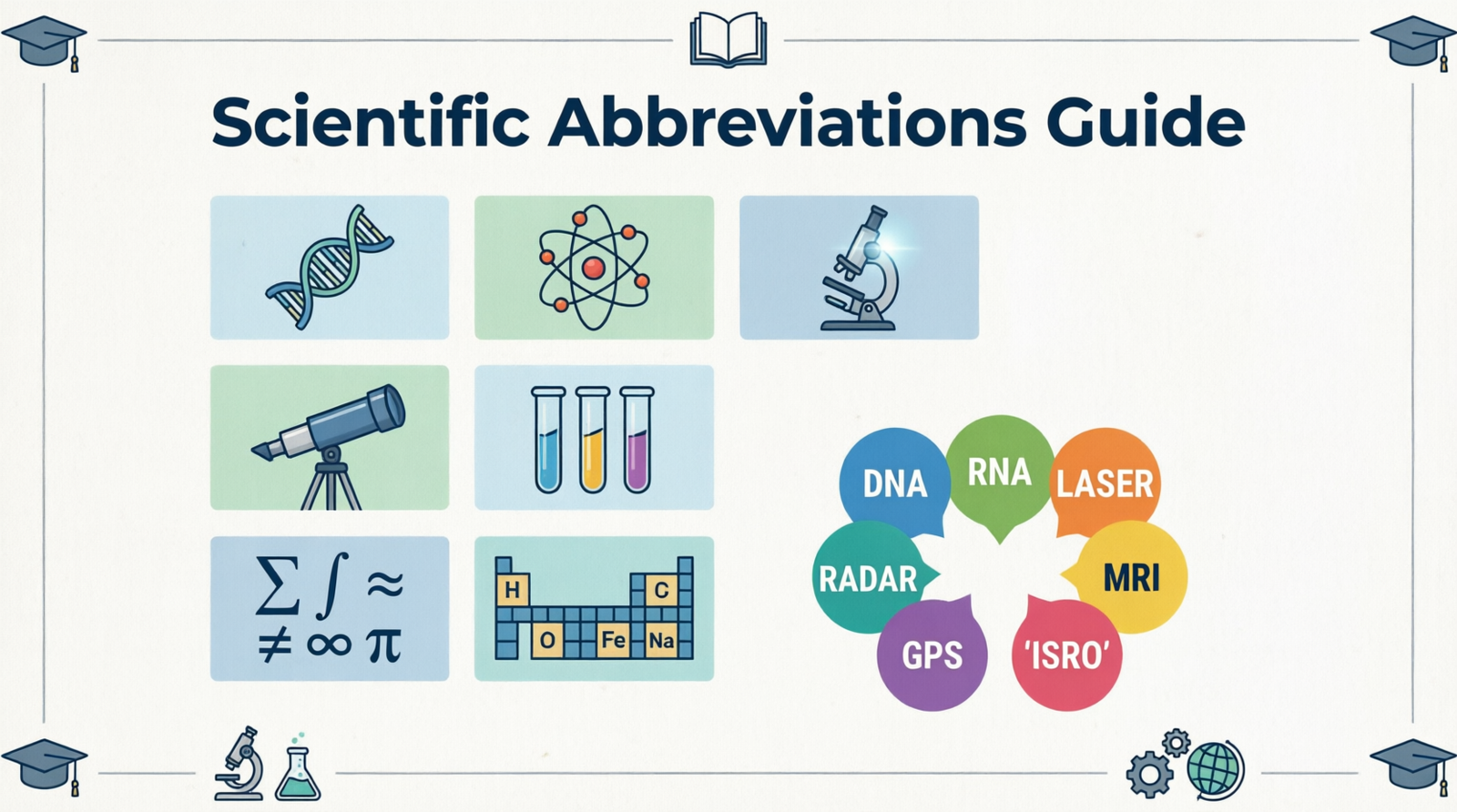
In the world of science, efficiency and precision are paramount. To communicate complex ideas quickly, scientists, researchers, and educators rely heavily on abbreviations and acronyms. For students preparing for competitive exams like VVM (Vidyarthi Vigyan Manthan), NEET, JEE, UPSC, or SSC, mastering these scientific abbreviations is not just helpful—it is essential.
This comprehensive study guide categorizes the most important and frequently asked scientific abbreviations, providing their full forms and a brief, easy-to-understand explanation. Bookmark this page for your daily revision!
1. Fundamental Physics & Chemistry Abbreviations
These are the building blocks of physical sciences, frequently appearing in textbooks and exam papers.
|
Abbreviation |
Full Form |
Brief Explanation |
|---|---|---|
|
LASER |
Light Amplification by Stimulated Emission of Radiation |
A device that emits a highly focused, coherent beam of light. |
|
RADAR |
Radio Detection and Ranging |
A system that uses radio waves to determine the distance, angle, or velocity of objects (e.g., aircraft, weather). |
|
SONAR |
Sound Navigation and Ranging |
A technique that uses sound propagation (usually underwater) to navigate or detect objects. |
|
pH |
Potential of Hydrogen |
A scale used to specify the acidity or basicity of an aqueous solution (0-14). |
|
ATP |
Adenosine Triphosphate |
The primary energy-carrying molecule found in the cells of all living things. |
|
CNG |
Compressed Natural Gas |
A cleaner-burning alternative to gasoline and diesel, primarily composed of methane. |
|
LPG |
Liquefied Petroleum Gas |
A flammable mixture of hydrocarbon gases (propane and butane) used as fuel. |
|
CFC |
Chlorofluorocarbon |
Organic compounds containing carbon, chlorine, and fluorine; known to deplete the ozone layer. |
|
LED |
Light Emitting Diode |
A semiconductor light source that emits light when current flows through it. |
|
LCD |
Liquid Crystal Display |
A flat-panel display technology that uses the light-modulating properties of liquid crystals. |
|
X-Ray |
X-Radiation |
A form of high-energy electromagnetic radiation used in medical imaging and crystallography. |
2. Biology, Medicine, and Health Sciences
Understanding medical and biological acronyms is crucial for life sciences, especially for NEET and general health awareness.
|
Abbreviation |
Full Form |
Brief Explanation |
|---|---|---|
|
DNA |
Deoxyribonucleic Acid |
The molecule that carries the genetic instructions for the development and function of living organisms. |
|
RNA |
Ribonucleic Acid |
A molecule essential in various biological roles, including coding, decoding, regulation, and expression of genes. |
|
AIDS |
Acquired Immunodeficiency Syndrome |
A chronic, potentially life-threatening condition caused by the HIV virus, which damages the immune system. |
|
HIV |
Human Immunodeficiency Virus |
The virus that causes AIDS by attacking the body’s immune system. |
|
MRI |
Magnetic Resonance Imaging |
A medical imaging technique used to visualize detailed internal structures of the body using strong magnetic fields. |
|
ECG / EKG |
Electrocardiogram |
A test that measures the electrical activity of the heartbeat to detect heart abnormalities. |
|
EEG |
Electroencephalogram |
A test that detects electrical activity in the brain using small, metal discs (electrodes) attached to the scalp. |
|
BCG |
Bacillus Calmette-Guérin |
A vaccine primarily used against tuberculosis (TB). |
|
DPT |
Diphtheria, Pertussis, and Tetanus |
A combination vaccine against three infectious diseases in humans. |
|
ORS |
Oral Rehydration Solution |
A specific type of fluid replacement used to prevent and treat dehydration, especially from diarrhea. |
|
BMI |
Body Mass Index |
A measure of body fat based on height and weight that applies to adult men and women. |
|
ICU |
Intensive Care Unit |
A specialized department in a hospital that provides intensive treatment medicine for critically ill patients. |
3. Space Science and Astronomy
With India’s growing footprint in space, these abbreviations are highly relevant for current affairs and science exams.
|
Abbreviation |
Full Form |
Brief Explanation |
|---|---|---|
|
ISRO |
Indian Space Research Organisation |
India’s national space agency, headquartered in Bengaluru. |
|
NASA |
National Aeronautics and Space Administration |
The independent agency of the U.S. federal government responsible for the civilian space program. |
|
PSLV |
Polar Satellite Launch Vehicle |
An expendable medium-lift launch vehicle designed and operated by ISRO. |
|
GSLV |
Geosynchronous Satellite Launch Vehicle |
An expendable launch system operated by ISRO to place satellites into geosynchronous transfer orbits. |
|
LVM3 |
Launch Vehicle Mark-3 |
Formerly known as GSLV Mk III, it is ISRO’s heaviest operational rocket, used for the Chandrayaan and Gaganyaan missions. |
|
ISS |
International Space Station |
A modular space station in low Earth orbit, a collaborative project involving five space agencies. |
|
LEO |
Low Earth Orbit |
An orbit around Earth with an altitude between 160 km and 2,000 km. |
|
GEO |
Geostationary Earth Orbit |
A circular geosynchronous orbit in the plane of the Earth's equator, approximately 35,786 km above the Earth. |
|
ESA |
European Space Agency |
An intergovernmental organisation dedicated to the exploration of space, headquartered in Paris. |
4. Premier Indian Scientific Organizations
For exams like VVM and UPSC, knowing the full forms of India’s top research bodies is mandatory.
|
Abbreviation |
Full Form |
Primary Focus |
|---|---|---|
|
CSIR |
Council of Scientific and Industrial Research |
India’s largest R&D organization, focusing on industrial and applied sciences. |
|
DRDO |
Defence Research and Development Organisation |
Responsible for developing cutting-edge defense technologies and missiles for the Indian Armed Forces. |
|
BARC |
Bhabha Atomic Research Centre |
India’s premier nuclear research facility, headquartered in Trombay, Mumbai. |
|
DAE |
Department of Atomic Energy |
The government department responsible for nuclear energy and research in India. |
|
ICAR |
Indian Council of Agricultural Research |
The apex body for coordinating, guiding, and managing research and education in agriculture. |
|
ICMR |
Indian Council of Medical Research |
The apex body in India for the formulation, coordination, and promotion of biomedical research. |
|
TIFR |
Tata Institute of Fundamental Research |
A national centre of the Government of India, under the umbrella of the DAE, focused on fundamental research. |
|
NCERT |
National Council of Educational Research and Training |
An autonomous organization that sets the curriculum and publishes textbooks for schools in India. |
5. Environmental and Earth Sciences
As climate change becomes a global priority, these abbreviations frequently appear in science and current affairs sections.
|
Abbreviation |
Full Form |
Brief Explanation |
|---|---|---|
|
IPCC |
Intergovernmental Panel on Climate Change |
The United Nations body for assessing the science related to climate change. |
|
UNEP |
United Nations Environment Programme |
The leading global environmental authority that sets the global environmental agenda. |
|
CFC |
Chlorofluorocarbon |
Synthetic compounds formerly used in refrigeration, known for ozone layer depletion. |
|
GHG |
Greenhouse Gas |
Gases in the Earth's atmosphere that trap heat (e.g., Carbon Dioxide, Methane, Water Vapor). |
|
ODP |
Ozone Depletion Potential |
A measure of the relative amount of degradation to the ozone layer a chemical can cause. |
|
BOD |
Biochemical Oxygen Demand |
The amount of dissolved oxygen needed by aerobic biological organisms to break down organic material in water (a key water pollution metric). |
|
COD |
Chemical Oxygen Demand |
A measure of the total quantity of oxygen required to oxidize all organic material into carbon dioxide and water. |
|
CNG |
Compressed Natural Gas |
Mentioned earlier, but also highly relevant as an eco-friendly alternative fuel. |
6. Computer Science and Modern Technology
The intersection of science and technology makes these acronyms essential for the modern student.
|
Abbreviation |
Full Form |
Brief Explanation |
|---|---|---|
|
AI |
Artificial Intelligence |
The simulation of human intelligence processes by machines, especially computer systems. |
|
ML |
Machine Learning |
A subset of AI focused on building systems that learn from data and improve over time. |
|
IoT |
Internet of Things |
The network of physical objects embedded with sensors and software to connect and exchange data. |
|
RAM |
Random Access Memory |
Volatile computer memory that temporarily stores data and machine code currently being used. |
|
ROM |
Read-Only Memory |
Non-volatile memory that permanently stores instructions for the computer to boot up. |
|
URL |
Uniform Resource Locator |
The address of a given unique resource on the Web (e.g., a website link). |
|
HTTP |
HyperText Transfer Protocol |
The foundation of data communication for the World Wide Web. |
|
GPS |
Global Positioning System |
A satellite-based radionavigation system owned by the US government, providing location and time information. |
⚠️ Commonly Confused Abbreviations (Exam Trap Alert!)
Competitive exams often try to trick students with similar-sounding or related abbreviations. Keep these distinctions clear:
- HIV vs. AIDS:
- HIV is the virus (Human Immunodeficiency Virus).
- AIDS is the syndrome/disease (Acquired Immunodeficiency Syndrome) caused by the advanced stage of HIV infection.
- ECG vs. EEG:
- ECG measures the heart’s electrical activity.
- EEG measures the brain’s electrical activity.
- RADAR vs. SONAR:
- RADAR uses Radio waves (works best in air/space).
- SONAR uses Sound waves (works best underwater).
- PSLV vs. GSLV:
- PSLV is for Polar orbits (sun-synchronous, lower altitude, used for earth observation).
- GSLV is for Geosynchronous orbits (higher altitude, used for communication satellites).
- DNA vs. RNA:
- DNA is double-stranded and contains the sugar Deoxyribose.
- RNA is typically single-stranded and contains the sugar Ribose.
📝 Quick Revision Checklist (For Last-Minute Prep)
- LASER: Light Amplification by Stimulated Emission of Radiation
- SONAR: Sound Navigation and Ranging
- DNA: Deoxyribonucleic Acid
- MRI: Magnetic Resonance Imaging
- ISRO: Indian Space Research Organisation
- PSLV: Polar Satellite Launch Vehicle
- DRDO: Defence Research and Development Organisation
- BCG: Bacillus Calmette-Guérin (TB Vaccine)
- CFC: Chlorofluorocarbon (Ozone depleter)
- BOD: Biochemical Oxygen Demand (Water pollution indicator)
💡 Did You Know? (Bonus Facts for Exams)
- The "X" in X-Ray: When Wilhelm Röntgen discovered this radiation in 1895, he didn't know what it was, so he used the mathematical symbol for an unknown quantity: "X". Hence, X-Ray literally means "Unknown Ray."
- EKG vs. ECG: They are the exact same thing! "ECG" is derived from the English term (Electrocardiogram), while "EKG" comes from the German term (Elektrokardiogramm). Both are accepted in medical science.
- Laser was once "Optical Maser": Before it was called LASER, it was referred to as an "optical maser" (Microwave Amplification by Stimulated Emission of Radiation).
- ISRO’s Heavy Lifter: LVM3 is powerful enough to carry 4,000 kg to Geosynchronous Transfer Orbit (GTO), making it the backbone of India’s human spaceflight program (Gaganyaan).
A Final Thought for Young Scientists
Abbreviations are not just shortcuts; they are the shorthand of scientific progress. Every acronym represents decades of research, discovery, and collaboration. When you write "DNA," you are invoking the double-helix discovery of Watson and Crick. When you write "ISRO," you are invoking the legacy of Vikram Sarabhai and the triumph of Chandrayaan-3.
By mastering these abbreviations, you are not just memorizing for an exam; you are learning the language of modern science.
Keep this guide handy, revise it regularly, and step into your exams with confidence!
Keywords : abbreviation abbreviations body brief earth exams explanation form full india isro light research science scientific space that these used you
🔔 हमारे YouTube चैनल को सब्सक्राइब करें:
👉 https://www.youtube.com/channel/UC76hj0iZcKkiW1YizHs0n2Q/
📘 Facebook Page:
👉 https://www.facebook.com/DigiTatvaPlus
🌿 वेबसाइट विजिट करें:
👉 https://www.bhaktipulse.com/
👉 https://www.bhaktipulse.com/video
✨ Guest Post Invitation – Share Your Divine Wisdom
🙏 Welcome to BhaktiPulse – your spiritual companion for Aarti, Chalisa, Bhajan, Mantra, and divine stories.
🌸 Do you have spiritual knowledge, devotional content, experiences, or stories that can inspire others?
📖 We warmly invite you to contribute your valuable content and become a part of our growing spiritual community.
✨ Your content may include:
- 🪔 Aarti, Chalisa, Mantra, Bhajan
- 📜 Spiritual stories & life lessons
- 🔍 Unknown facts & scientific reasons in Sanatan Dharma
- 🌿 Ayurveda, rituals, and traditions
💡 If your content aligns with our vision, we will proudly feature it on BhaktiPulse.
📩 Submit your content or contact us here:
👉 https://www.bhaktipulse.com/contact.php
🌼 Let your words spread devotion, ज्ञान, and positivity to the world.
🙏 Join us in this divine journey!
💬 Comments
Approved Comments